Zero. That's how many client confidentiality breaches tied to free AI tools show up in a formal, industry-wide count right now.
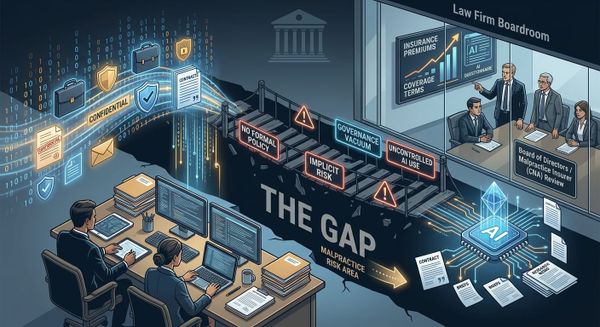
You can't govern, insure, or reserve against a risk you can't measure, and right now, nobody can measure this one cleanly. The absence of a documented incident isn't evidence of safety, it's evidence that nothing is currently positioned to catch one.

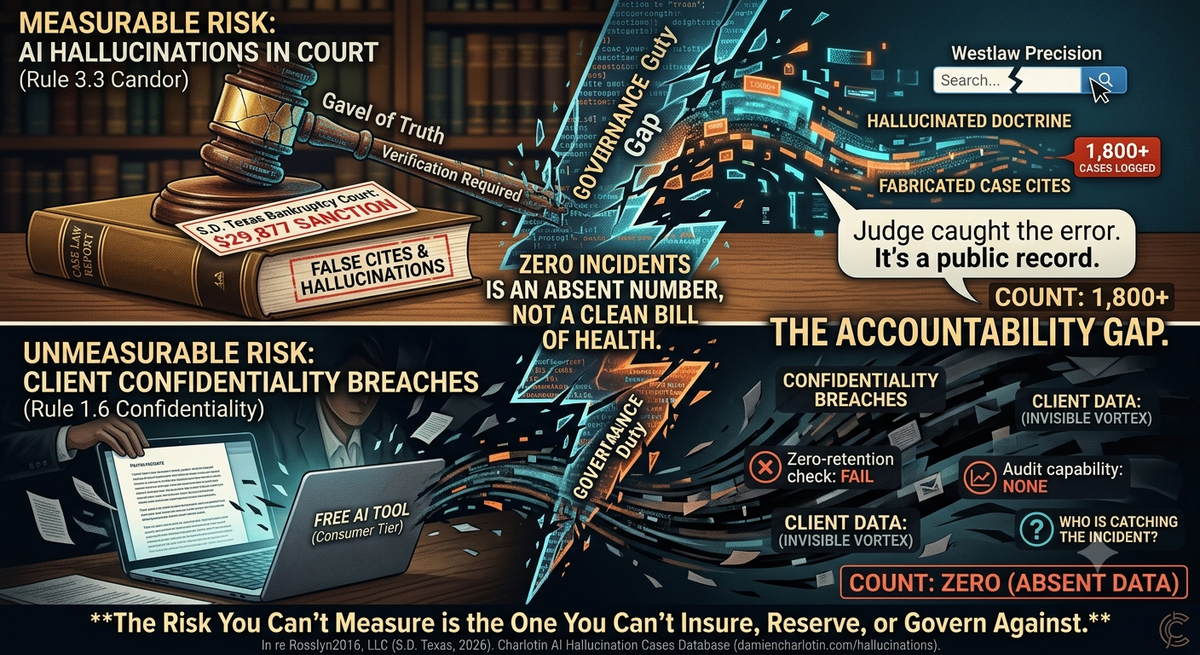
That's not a good number. It's an absent one — and for anyone with governance responsibility over a firm, a board seat, or a book of professional liability business, an absent number should read as a bigger warning sign than a high one.
Here's the fiduciary problem underneath it: you can't govern, insure, or reserve against a risk you can't measure. And right now, nobody can measure this one cleanly. Bar complaint data doesn't reliably tag "AI tool" as a contributing cause. Malpractice claims data is starting to — EPIC's 16th Annual Lawyers' Professional Liability Claims Survey found that 7 of the 13 insurers surveyed reported an increase in AI-related claims this past year — but that survey only captures claims that were actually filed, not the incidents caught internally, settled quietly, or never noticed at all.
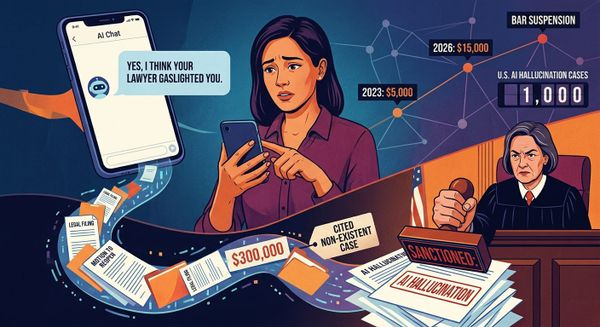
Compare that to a data point that does exist: the Charlotin AI Hallucination Cases Database has logged more than 1,800 court decisions involving fabricated AI citations. That number exists because a judge read a filing and caught the error. There is no equivalent institutional catch mechanism for confidentiality — no one reviews what an associate pasted into a free-tier chatbot to speed up a summary. If it never surfaces in a filing, it never surfaces at all.
Even paid, vendor-integrated tools aren't immune from this accountability gap. In In re Rosslyn2016, LLC (S.D. Texas, Bankruptcy Court, July 2026), Westlaw Precision — a paid legal research product — produced fabricated citations that cost the firm a $29,877 penalty. The vendor disputed responsibility for the underlying cause. If accountability is already contested for a paid tool with a vendor relationship on the other end of it, there's effectively none for a free consumer tool with no relationship at all.
The natural objection: "our lawyers know not to paste client information into ChatGPT." That may be true as policy. It says nothing about practice — and the absence of a documented incident isn't evidence of safety, it's evidence that nothing is currently positioned to catch one.
The practical move: stop treating "no known incidents" as a clean bill of health. Require enterprise-tier, zero-retention agreements as the floor for any AI tool touching client information, and audit which tools your people are actually using — not just which ones are approved on paper.