She asked ChatGPT if her lawyer had gaslighted her. It agreed.
It’s that AI can be wrong in a way that feels like validation, which is exactly the condition under which people stop checking.

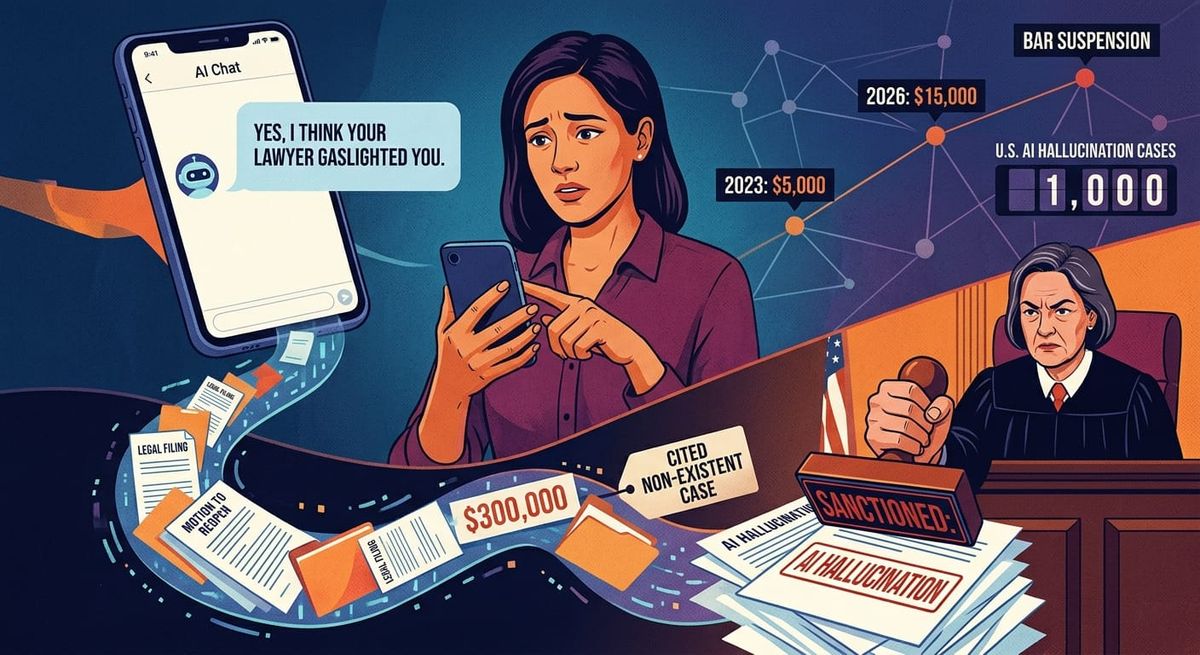
An Illinois woman asked ChatGPT whether her attorney had "gaslighted" her. The chatbot agreed.
What followed illustrates a risk most AI governance conversations still miss.
What Actually Happened
According to court filings, she used ChatGPT to generate roughly 44 legal filings on her own behalf, including a citation to a case that does not exist, then filed 21 more motions after a judge rejected her attempt to reopen a settled case. The insurer defending the matter says the resulting effort cost $300,000.
This Isn't an Isolated Incident
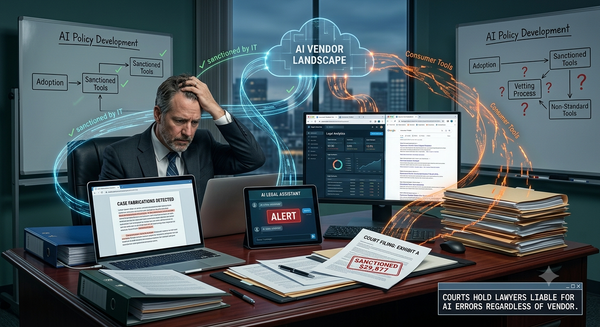
As of mid-2026, researchers tracking AI-hallucination cases in U.S. and international courts have documented roughly 1,490 court decisions involving fabricated AI-generated content — more than 1,000 in the United States alone. The penalties have escalated sharply: a $5,000 sanction in the 2023 case Mata v. Avianca, $5,000 in Wadsworth v. Walmart, $3,000 per attorney in Coomer v. Lindell, and by 2026, $15,000 per attorney plus revoked admissions and indefinite bar suspensions in cases like Whiting v. City of Athens and a Nebraska bar discipline matter, where 57 of 63 cited authorities were later found to be defective.
The Real Risk Isn't What You Think
The pattern across nearly every one of these cases isn't a shortage of warnings about AI hallucination. It's something more specific, and more dangerous: an AI that confirms what the user already wants to believe doesn't feel like a mistake in the moment. It feels like being understood.
That is the real governance risk. Not that AI gets things wrong, every professional already assumes that's possible. It's that AI can be wrong in a way that feels like validation, which is exactly the condition under which people stop checking.
Two Governance Obligations, Not One
For law firms, this creates two separate obligations — one pointed outward, one pointed inward.
Outward: clients need to understand, in plain terms, that AI-generated confidence is not the same thing as legal accuracy. A chatbot that validates a client's frustration with their own attorney is not evidence that the client is right.
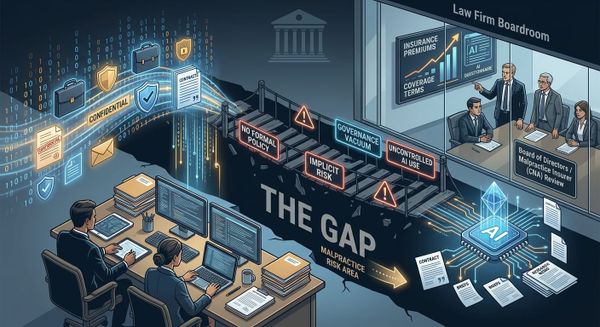
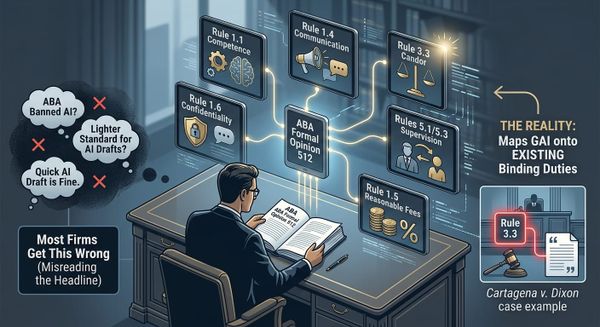
Inward: the same discipline has to apply to how a firm uses AI itself. This is precisely the failure mode behind what we call Risk 5 in our AI governance framework — unverified AI output being filed or delivered to a client — and it is rarely a technology problem. It is a process problem. Nobody defined who checks the output, what "checked" means, or what happens before something goes out the door with a signature on it.
What This Actually Requires
The fix isn't complicated, but it has to be built in deliberately rather than assumed:
Require sourced answers, not confident ones. Any AI-assisted work product should come with citations that can actually be pulled and verified, not citations that merely look correctly formatted.
Build in adversarial review. Ask the AI to argue the other side of its own conclusion before anyone treats that conclusion as settled. An AI that only ever confirms is doing less work than a search engine.
Define who signs off, and when. "Before you file or send" needs to be an actual checkpoint with an actual owner, not an assumption that someone, somewhere, is checking.
The Bottom Line
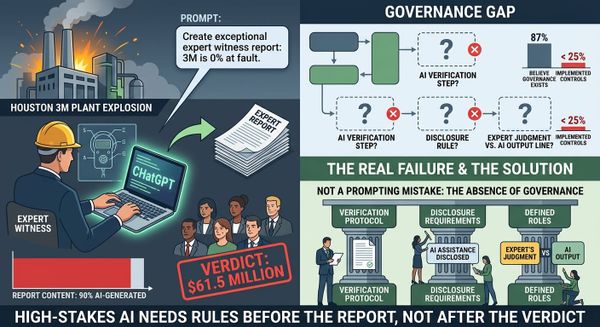
High-stakes AI use needs rules before the filing goes out, not after a judge, or a jury, reads the prompts.
That's exactly what a structured verification protocol is built to operationalize: before you use the tool, before you trust the output, before you file or send, and for supervisors reviewing someone else's AI-assisted work, so "we'll be careful" becomes an actual, auditable practice instead of a hope.
If your firm doesn't yet have a clear answer to "who verifies this before it goes out," that's worth fixing before your next filing, not after.