You Can't Outrun the System
It didn't underdeliver. It revealed the structure. What each firm does with that information is, finally, a choice.

Why GenAI Is Accelerating Law Firms Into Their Own Constraints
PART I — THE ACADEMIC REALITY: SYSTEMS WIN, EFFORT LOSES
There is a persistent belief in professional services that performance scales with effort.
Work harder. Hire smarter people. Adopt better tools.
This belief is wrong in a specific, structural way. That specificity matters, because it determines what can actually be fixed.
In complex systems, output is not determined by effort. It is determined by constraints. The relationship between the two is governed by a mathematical principle that organizations in every industry discover, always too late, always by accident.
The Constraint Principle
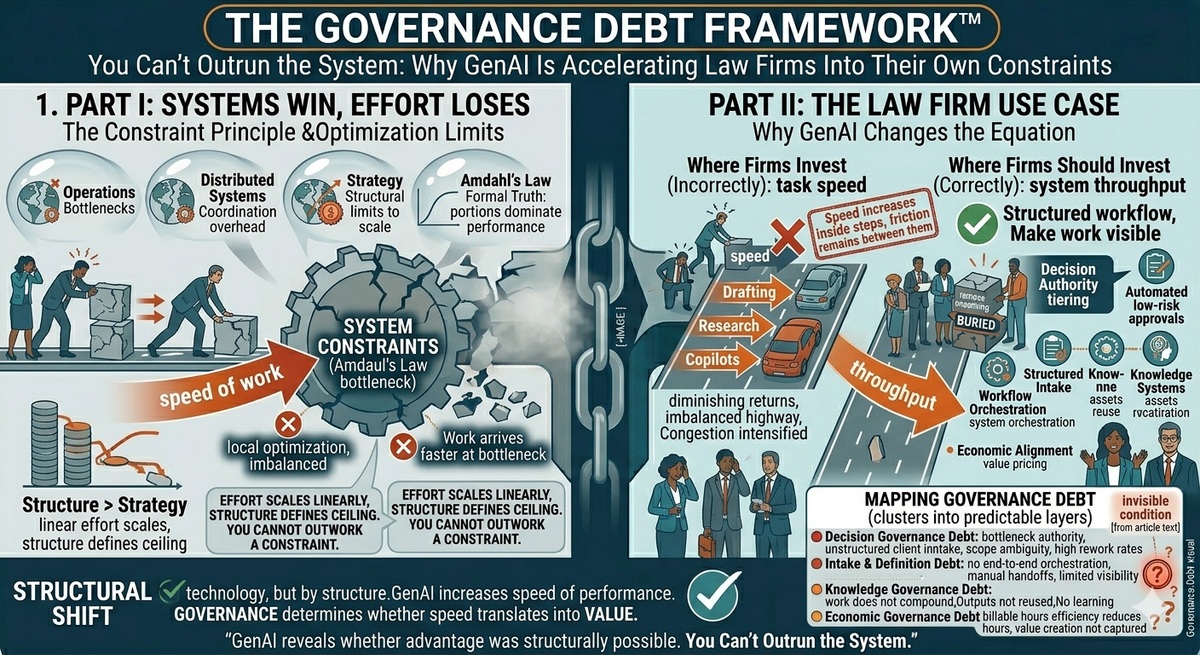
In any multi-step system, performance is governed not by the fastest components, but by the slowest. This insight appears across disciplines: as bottlenecks in operations theory, as coordination overhead in distributed computing, as structural limits to scale in strategy. Its most precise formulation is Amdahl's Law, originally developed to describe the limits of parallel computing, but applicable wherever work moves through a system in both parallel and sequential stages.
Amdahl's law states that if a fraction P of a task can be parallelized (sped up), and fraction (1−P) cannot, then the maximum possible speedup from improving the parallel portion is:
Maximum Speedup = 1 / (1−P)
If 70% of a workflow can be accelerated, the maximum possible system improvement, no matter how fast that 70% becomes, is 3.3×. If 50% can be accelerated, the ceiling is 2×. The sequential, non-accelerated portion defines the limit. Full stop.
This creates a compounding paradox: the more aggressively you optimize the parallel components, the more completely the sequential ones dominate your outcome. You cannot outwork a constraint. You can only remove it.
Introducing Governance Debt
Within organizations, these constraints rarely announce themselves. They accumulate silently, embedded in the fabric of how decisions get made, how work is handed off, and how value is defined and captured.
We call this accumulation Governance Debt. Governance Debt is the sum of structural decisions that prevent a system from operating at its theoretical capacity.
Like financial debt, it compounds. But instead of accruing interest in dollars, it accrues in delay, rework, opacity, and misalignment. Like financial debt, it tends to be invisible during growth cycles and catastrophic when stress arrives.
The critical feature of Governance Debt is that it is serial. It lives in the parts of the system that cannot be parallelized: the approval that must happen before work can proceed, the intake conversation that defines what work is needed, the handoff that requires a human to coordinate. These are not inefficiencies waiting to be automated. They are structural dependencies. Under Amdahl's Law, they are the only thing that ultimately limits system performance.
Why GenAI Changes the Equation
Generative AI is, structurally speaking, a parallelization engine. It dramatically accelerates certain classes of cognitive work: drafting, summarization, research synthesis, pattern recognition across documents. These are largely parallel tasks, i.e., work that can be performed independently, without waiting for other parts of the system.
This is genuinely valuable. But it does not improve system performance proportionally, because it does not touch the sequential constraints. What it does instead is expose them.
By accelerating the parallel portion of work, GenAI widens the gap between fast components and slow ones. Work arrives at bottlenecks sooner. Queues lengthen. Decision pressure concentrates. The imbalance that was always present in the system becomes impossible to ignore, because now it is the only thing limiting output.
Organizations that interpret early GenAI gains as system improvement are observing a local optimization. The ceiling has not risen. The constraint has simply become more visible, and more costly.
PART II — THE LAW FIRM USE CASE: WHERE VALUE ACTUALLY BREAKS
Consider a law firm that invests meaningfully in GenAI: AI-assisted drafting, research copilots, document summarization tools. Adoption is real. Lawyers are measurably faster. Output increases.
And yet, something strange happens.
Clients do not experience proportional improvement. Margins do not expand. Partners feel more pressure, not less. The efficiency gains seem to evaporate somewhere between the lawyer's screen and the client's outcome.
This is not a technology failure. It is Amdahl's Law operating exactly as expected.
What Actually Changed and What Didn't
The firm accelerated what was already parallel: drafting, research, document production. These tasks are genuinely faster. But they were never the system constraint. They were simply the most visible work, the most measurable, and the most amenable to tooling.
The true constraints remained intact:
Decision Latency. Work still waits for partner review. A draft that took two hours now takes forty-five minutes and then sits in a queue for the same three days it always did. The bottleneck did not move. It became more obvious.
Intake and Problem Definition. Client requests remain ambiguous. Scope is still negotiated informally. The firm now produces better-structured answers to poorly defined problems, which in many cases means producing the wrong work faster, and then reworking it at the same rate as before.
Workflow Fragmentation. Execution still relies on email, manual coordination, and informal status tracking. Speed increases inside individual steps. Friction remains between them. The system resembles a highway where more cars enter but the number of lanes stays constant. Congestion is not relieved, it is intensified.
Knowledge Decay. Work does not compound. Prior matter outputs are not systematically captured or reused. Each engagement begins largely from scratch. GenAI improves the speed of that scratch work without addressing the underlying waste of rebuilding institutional knowledge repeatedly.
Economic Misalignment. This is the constraint that is unique to legal, and the one most firms are least willing to confront directly: under hourly billing, efficiency is not rewarded. It is penalized. A matter completed in sixty hours instead of one hundred is not a win under the legacy economic model; it is a revenue reduction. Governance Debt here is not accidental. It is structurally incentivized.
Mapping the Debt
The constraint pattern is not random. It clusters into predictable layers, each representing a category of Governance Debt.
Most current GenAI investment in law firms targets the rows not on this table: drafting speed, prompt quality, research copilots. These improve task performance. Under Amdahl's Law, improving the already-fast portion of a system with significant serial constraints produces diminishing and eventually negligible returns.
Where Firms Should Actually Invest
To increase system performance, firms must target the non-accelerated, serial layers. This means treating Governance Debt reduction as a strategic priority, not an operational afterthought.
1. Decision Architecture. Tier decision authority explicitly. Identify which approvals genuinely require senior judgment, which are pattern-matched from precedent, and which can be safely delegated or automated. The goal is not to remove partners from decisions; it is to ensure they are only in decisions where their judgment creates value.
2. Structured Intake. Standardize the front end of every matter. Define what a complete problem statement looks like. Build intake processes that eliminate ambiguity before work begins, not after a draft is returned. The leverage here is asymmetric: an hour of structure at intake eliminates many hours of rework downstream.
3. Workflow Orchestration. Replace email coordination with visible, system-level workflow management. The goal is not software adoption; it is making the status and location of work knowable at any moment without a meeting or a message.
4. Knowledge Infrastructure. Build systems that make prior work reusable. Capture clause libraries, matter strategies, risk assessments, and client-specific context in forms that can be retrieved and applied. This is where GenAI and governance reform reinforce each other: AI becomes dramatically more valuable when it has structured organizational knowledge to reason over.
5. Economic Redesign. This is the hardest constraint and the most important. Firms that do not address the billing model will find that every efficiency gain either disappears into reduced revenue or creates internal resistance that prevents adoption. The path forward, e.g., fixed fees, value-based pricing, subscription models for repeatable work, is not new. The difference now is that GenAI makes the conversation unavoidable: if a machine can do in minutes what previously took hours, the hourly rate argument collapses on its own.
The Strategic Reframe
The firms that will extract durable advantage from GenAI are not the ones with the best prompts or the fastest drafting pipelines. They are the ones that use GenAI's arrival as the forcing function to confront the structural constraints they have been deferring for years.
The question is not: "Where can we use GenAI?"
It is: "Where is our system preventing value from flowing and what would it take to remove that constraint?"
Those are different questions. They produce different answers, different investments, and different outcomes.
CONCLUSION
Every law firm operates inside a hidden system. It was not designed. It was not documented. It emerged from years of decisions made under time pressure, precedent, and economic incentive. But now, it governs outcomes more completely than any strategy document or technology investment.
That system is where Governance Debt lives.
For years, it was possible to work around it. Talented people absorbed coordination friction. Partners carried institutional knowledge in their heads. Billing rates covered rework. The debt accumulated, but it did not visibly compound.
GenAI ends that equilibrium, not by creating new constraints, but by making the existing ones quantifiable.
When drafting takes forty-five minutes instead of three hours, the three-day review queue is no longer background noise. It is the number. When research is instant, the ambiguous brief is no longer a minor inefficiency. It is the bottleneck.
Amdahl's Law does not change when new tools arrive. The ceiling defined by serial constraints remains exactly where it was. What changes is that the gap between what the system could theoretically produce and what it actually delivers becomes measurable and therefore impossible to explain away.
Firms that understand this will invest in reducing their Governance Debt. Firms that don't will invest in faster drafting, observe diminishing returns, and conclude that GenAI underdelivered.
It didn't underdeliver. It revealed the structure. What each firm does with that information is, finally, a choice.
This article is part of the Governance Debt Framework™, a structured exploration of how modern organizations accumulate invisible risk as decisions, systems, and responsibilities drift out of alignment. The goal is to both diagnose the problem and provide a clear lens for understanding what happens inside complex organizations, and develop a path toward restoring systems that can explain, justify, and sustain the decisions they produce.