What Is Actually Governable? Redefining Control in AI Systems
Control over AI systems is not a destination. It is a practice.

The Question the Series Has Been Building Toward
You have traveled considerable distance to arrive here. Governance Debt, the series established, accumulates through rational decisions made by capable people inside organizations that never demanded otherwise. You traced it through the boundaries where it concentrates, the systems it renders inexplicable, the authority vacuums that allow it to persist, the hidden timeline along which it compounds, and the convergence point where AI transforms the cost of carrying that debt from manageable to permanent. You audited your own governance ceiling, calculated what it costs, and received the method for reconciliation.
What you have not yet received is the answer the whole sequence was preparing you to ask precisely: once foundational conditions exist, once reconciliation has established traceability, transformation transparency, and visible system interactions, what does genuine, sustained control over AI systems actually look like? What is controllable, and what is not? What does success mean, and how will you recognize it when you are achieving it?
Those questions are what this article answers. They determine whether the preceding work produces durable governance or a more sophisticated version of the governance posture problem, better foundations, same passive relationship to maintaining them.
The answer begins with a reframing. That reframing, once understood, changes how governance is practiced.
Control Is Not a Destination
The implicit goal embedded in most AI governance initiatives is the achievement of control, a state in which the system is fully governed, the frameworks are implemented, the documentation is complete, and the organization can proceed with confidence. This goal is understandable. It is also the framing that most reliably produces governance that erodes.
Control over AI systems is not a destination. It is a practice. Not a state that is achieved and maintained passively; a discipline that is actively sustained, continuously extended, and deliberately defended against the pressures that will begin eroding it from the moment reconciliation is complete.
This is not a diminishment of what you have been working toward. It is its maturation. The distinction between control as destination and control as practice is the distinction between governance that holds for two years and governance that holds for twenty. Between an organization that achieves foundational clarity and then gradually re-accumulates the debt that reconciliation cleared, and one that builds the organizational disciplines that prevent that re-accumulation.
The series established in its third article that Governance Debt accumulates because incentive structures reward delivery over explainability, not through failure of competence but as a predictable outcome of how organizations are structured and rewarded. That dynamic does not disappear when reconciliation is complete. It reasserts itself in the next project that runs behind schedule, the next team that inherits a system without inheriting its documentation, the next architectural decision that prioritizes integration speed over transformation transparency. Without deliberate organizational design to sustain what reconciliation established, those conditions will erode. Not immediately. Not visibly. Exactly the way Governance Debt accumulated in the first place: gradually, rationally, one defensible decision at a time.
The reader who replaces the goal of achieving control with the goal of practicing it is the reader who will be governing their AI systems effectively in five years rather than managing the next iteration of the debt this series diagnosed.
The Honest Boundaries of Governance
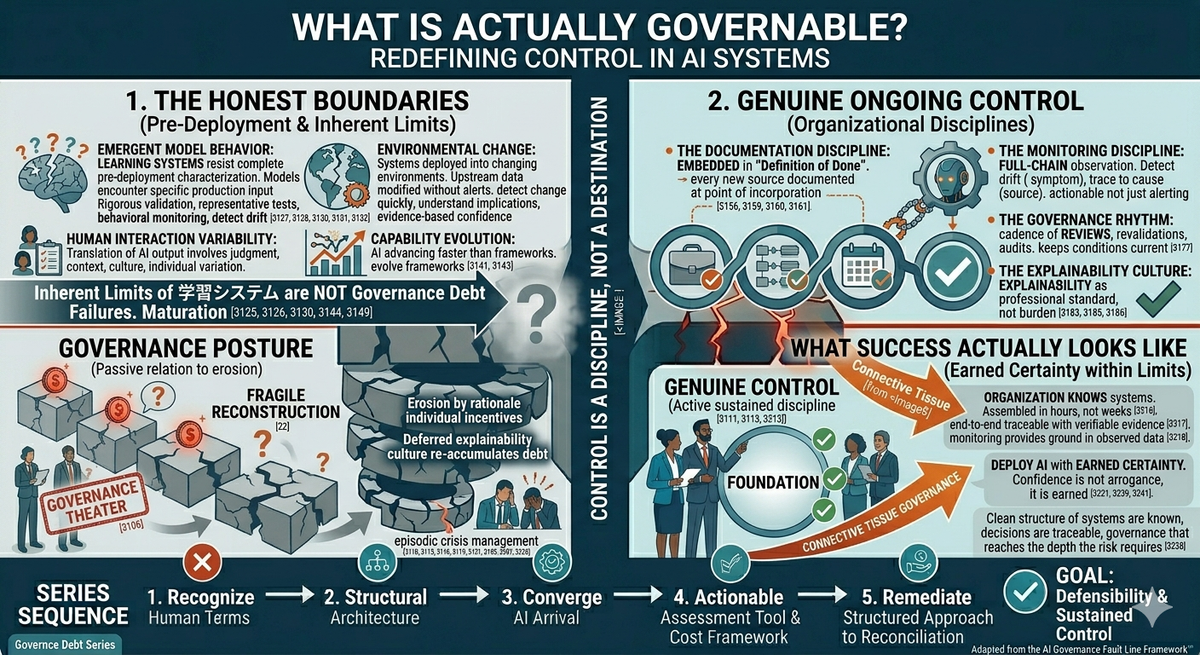
Before establishing what genuine ongoing control looks like, the series owes you something governance frameworks rarely provide: an honest account of what is not fully governable in AI systems, even when foundational conditions are excellent.
These limits are real, and reconciliation will not eliminate them. Naming them is not a concession to ungoverned AI. It is the intellectual honesty that distinguishes mature governance from governance theater.
Emergent model behavior is the first boundary. AI models develop behaviors that reflect patterns in training data in ways that cannot be fully predicted before deployment. A model's behavior on the specific distribution of inputs it encounters in production may differ from what validation anticipated, not because of a documentation failure, but because learning systems resist complete pre-deployment characterization. Governance can substantially reduce this uncertainty through rigorous validation, representative test construction, and ongoing monitoring of production behavior against baselines. It cannot eliminate it. The honest governor designs monitoring to detect behavioral drift early rather than assuming validation has fully characterized behavior in advance.
Environmental change is the second boundary. AI systems are deployed into environments that shift in ways the model was not trained for and governance frameworks cannot fully anticipate. Economic conditions move. Regulatory requirements evolve. Upstream data sources are modified in ways that alter input distribution without triggering alerts designed for more dramatic changes. What governance can do, what distinguishes organizations with genuine foundational governance from those without it, is detect these changes quickly, understand their implications through the chain visibility that foundational governance provides, and respond with the evidence-based confidence that comes from actually knowing the system.
Human interaction variability is the third boundary. Governance can document how AI outputs are designed to be used. It cannot fully govern how they are actually used by the humans and processes that receive them. The translation between an AI output and a human decision involves judgment, context, organizational culture, and individual variation that documentation cannot fully capture. Governance can establish clear decision rules, require documentation of how outputs were applied, and audit that application, but the variability introduced by human judgment at the point of use is a boundary genuine governance acknowledges rather than pretends to have eliminated.
Capability evolution is the fourth. AI capabilities advance at a rate that consistently exceeds the rate at which governance frameworks are developed, tested, and validated. New architectures, new training approaches, and new deployment configurations regularly introduce challenges that existing frameworks were not designed to address. This is not an argument against frameworks. It is an argument for building governance organizations with the capacity to evolve their frameworks as capabilities evolve, rather than treating frameworks as fixed specifications and discovering, when capabilities have moved beyond them, that governance has been addressing last year's risk profile.
These boundaries define the space within which genuine governance operates. They are real and permanent. They are also narrower than the ungoverned space Governance Debt creates. Closing the gap between your current governance ceiling and these inherent limits is the work the series has equipped you to do. Operating with clarity and discipline within those limits is the practice that sustains it.
What Genuine Ongoing Control Looks Like
Within the honest boundaries of what is governable, genuine ongoing control is specific, observable, and achievable. It requires four organizational disciplines active simultaneously and sustained continuously. Each is distinct from reconciliation, reconciliation establishes the conditions; these disciplines maintain and extend them.
The documentation discipline is the ongoing practice that prevents new Governance Debt from accumulating on the foundations reconciliation cleared. Every new data source incorporated into an AI chain is documented at the point of incorporation, provenance, collection method, known limitations, validation status, not after the fact, not during the next audit cycle, not when someone remembers. Every transformation applied to data is specified before or at the time of implementation, reasoning documented alongside logic. Every system interaction, every boundary crossing, every dependency, every assumption a component makes about what it receives, is recorded in a living map updated when the interaction changes rather than when the change causes a problem.
This discipline requires documentation be embedded in the operational definition of done for every project that touches AI-dependent systems. Not as a separate workstream. Not as a post-project activity, the deferral that is the mechanism of accumulation, but as a condition of completion evaluated before a project is considered finished. When documentation is a condition of completion, it is funded and prioritized as part of delivery. When it is a post-project activity, it is the first thing deferred when the next project begins.
The monitoring discipline is the architecture of ongoing observation that can detect the behavioral boundaries described above and connect those observations back through the full chain to their causes. Monitoring that operates only at the model output layer sees the symptom but not the source. It can detect that outputs have changed; it cannot determine whether the change originated in the model, in transformation logic applied to its inputs, in the characteristics of the data source feeding the pipeline, or in a system interaction that changed without triggering formal change management.
Monitoring that reaches the full chain, observing data at the point of origin, at transformation boundaries, at system interaction points, and at model input and output, can detect the source as well as the symptom. It can distinguish model drift from data drift, and data drift from transformation logic change, and transformation logic change from upstream system modification. That distinction is what makes monitoring actionable rather than merely alerting. An alert that tells you something changed is the beginning of an investigation. An alert that tells you what changed and where in the chain it originated is the foundation of a response. This operational payoff requires the foundational conditions that reconciliation established, monitoring can only observe what documentation has made observable.
The governance rhythm is the structured cadence of reviews, revalidations, lineage audits, and organizational assessments that keep foundational conditions current as systems evolve and as the environment changes around them. It prevents the gradual drift between documented system state and actual system state that is one of the primary mechanisms through which new Governance Debt accumulates even in organizations that completed reconciliation.
At minimum: quarterly lineage audits verifying that documented chains match actual chains; annual model revalidation assessing performance against current data distributions; semi-annual reviews of system interaction maps confirming that dependency documentation reflects actual behavior; ongoing monitoring of regulatory developments requiring framework updates before formal compliance deadlines. The specific cadence matters less than consistency of execution, particularly through the periods when nothing appears to be wrong. Those are the periods when new debt accumulates. Consistent governance rhythm is the mechanism that keeps accumulation visible rather than hidden.
The explainability culture is the organizational condition that sustains the preceding three disciplines against the pressures continuously working to erode them. It is the most difficult to establish and the most important to maintain, because it determines whether the documentation discipline, the monitoring discipline, and the governance rhythm are treated as genuine operational requirements or as compliance exercises to be satisfied at minimum viable effort.
Explainability culture is present when the people doing the work, the data engineers, the model developers, the architects making integration decisions, treat the ability to explain their work as a professional standard, not an administrative burden. When a team asked why it made a particular design decision answers with documented reasoning rather than reconstructed memory, not because an auditor asked but because the team considered documentation a necessary part of doing the work well. When a manager asked to approve a release that does not meet documentation standards declines, not because policy requires it, but because undocumented systems are considered incomplete systems.
This culture does not emerge from policy alone. It emerges from policy, incentive structures, leadership modeling, and the accumulated organizational experience of seeing what happens when explainability is treated as optional. The culture of deferring explainability was built over years through incentive structures that rewarded delivery over documentation. The culture of treating explainability as a professional standard must be built with the same patient, structural deliberateness, through metrics that measure governance quality alongside delivery performance, through recognition that treats documented systems as higher quality than undocumented ones, and through leadership that models the behavior it is asking of the organization by asking for explanations rather than accepting confident assertions.
Sustaining Governance Against Organizational Pressure
The four disciplines of genuine ongoing control are clear in description. They are demanding in practice, because they operate in the same organizational environment that generated Governance Debt in the first place, an environment that will continue to generate delivery pressure, resource competition, and the rational individual incentives the series diagnosed as the primary mechanism of accumulation. Three design elements are essential to sustaining governance against these pressures.
Governance metrics must be embedded in performance evaluation. Organizations measure what they manage and manage what they measure. If teams and leaders are evaluated only on delivery performance, on time, on budget, on scope, then delivery will consistently be optimized at the expense of governance quality. When governance metrics are added to performance evaluation, documentation completeness at point of release, lineage audit findings attributable to the team, monitoring coverage of chain components, governance quality becomes something rational people have reason to optimize rather than minimize. The metrics do not need to be complex. They need to be real: actual inputs to actual performance evaluations, with actual consequences for consistent non-performance.
Governance authority must be sustained at the level reconciliation established. The authority vacuum that article six identified as the reason Governance Debt persists does not resolve itself when reconciliation is complete. The organizational tendency after reconciliation is to return governance authority to its pre-reconciliation distribution, back into domain-scoped functions without cross-chain visibility or mandate. That distribution is the one that produced the accountability gap in the first place. Sustaining governance requires that the cross-chain authority established for reconciliation be converted into a permanent organizational structure; one with equivalent visibility, equivalent mandate, and equivalent authority to enforce foundational standards across the boundaries where debt most reliably accumulates.
Investment in foundational governance must be treated as operational cost, not capital project. The most common failure mode in post-reconciliation governance is the reclassification of governance investment from ongoing operational cost to periodic capital project, reconciliation treated as a project with a completion date, its resources released when that date is reached, governance reverted to the pre-reconciliation model until the next accumulation crisis demands another project. Preventing this failure mode requires that governance investment be budgeted as a recurring operational cost, reviewed at the governance authority level, and protected from the project portfolio reallocation pressures that will otherwise claim it.
What Success Actually Looks Like
Success in governing AI systems does not look like perfection. It does not look like a state in which every aspect of every AI system is fully documented, fully validated, and fully controlled in every dimension. That state does not exist for AI systems operating in complex organizational environments, and pursuing it as a goal produces governance theater, the performance of complete control rather than the practice of genuine control within honest boundaries.
Success looks like this: your organization knows its AI systems. Not approximately, not through the institutional memory of people who built them and may not always be present, but through documentation created as a matter of operational discipline, retrievable by anyone with appropriate access. When a regulator asks how a specific decision was reached, the answer is assembled from existing documentation in hours, not from working groups over weeks. When a legal challenge requires end-to-end reconstruction of a consequential output, the chain is traceable with verifiable evidence at every step. When an internal review asks whether a model is still performing within validated parameters, the monitoring architecture provides an answer grounded in observed data, not in the assumption that nothing has changed since the last validation.
Your organization can explain itself. To the full depth of the chains those frameworks depend on, not merely to the limit of what governance frameworks cover. The governance ceiling the audit test located has been raised, not necessarily to the inherent limits of what is governable, but close enough to those limits that the space between them is understood, actively monitored, and honestly disclosed rather than unknown and therefore unmanaged.
Your organization can deploy AI with confidence in the highest-stakes contexts where its value is greatest. Not because risk has been eliminated, it has not, but because the foundational conditions that make AI deployment credible to regulators, auditors, counterparties, and the people affected by AI decisions have been established and are being maintained. The competitive and operational value that Governance Debt was preventing, use cases not pursued, markets not entered, regulatory approvals not sought, is now accessible. Each AI use case deployed on adequate foundational governance extends a foundation of organizational knowledge rather than adding to an accumulation of organizational debt. Each team that treats explainability as a professional standard is building the organizational capability that distinguishes durable AI governance from episodic crisis management.
That confidence is not arrogance. It is the earned certainty of an organization that has done the work.
The Work, and Why It Is Worth It
This series began by naming a condition that most organizations were carrying without having named it. It traced that condition through its causes, its structures, its consequences, and its costs. It asked you to find it in your own organization, to calculate what it costs you, and to understand the method for addressing it.
The work was necessary. Not because Governance Debt is an abstract risk to be managed at arm's length, but because the decisions AI systems are making, about credit, clinical care, employment, operational risk, the allocation of resources and opportunities that affect real people's real lives, deserve to be made by systems genuinely understood by the organizations deploying them. Governance Debt is not only an organizational liability. It is a failure of the accountability that consequential decision-making demands.
Reconciliation and sustained governance are how that accountability is established and maintained. They are how an organization moves from the condition this series diagnosed, systems that function but cannot explain themselves, governance that is present but not functional, AI that is deployed but not genuinely controlled, to the condition this series has been pointing toward: systems that are known, decisions that are traceable, governance that reaches the depth the risk requires.
The work begins, or continues, or deepens, with what you now know.
This article is part of the Governance Debt Framework™, a structured exploration of how modern organizations accumulate invisible risk as decisions, systems, and responsibilities drift out of alignment. The goal is to both diagnose the problem and provide a clear lens for understanding what happens inside complex organizations, and develop a path toward restoring systems that can explain, justify, and sustain the decisions they produce.