The Seam No One Owns: Why AI Governance Fails Between Teams
No one owns the seam.

The Seam Problem
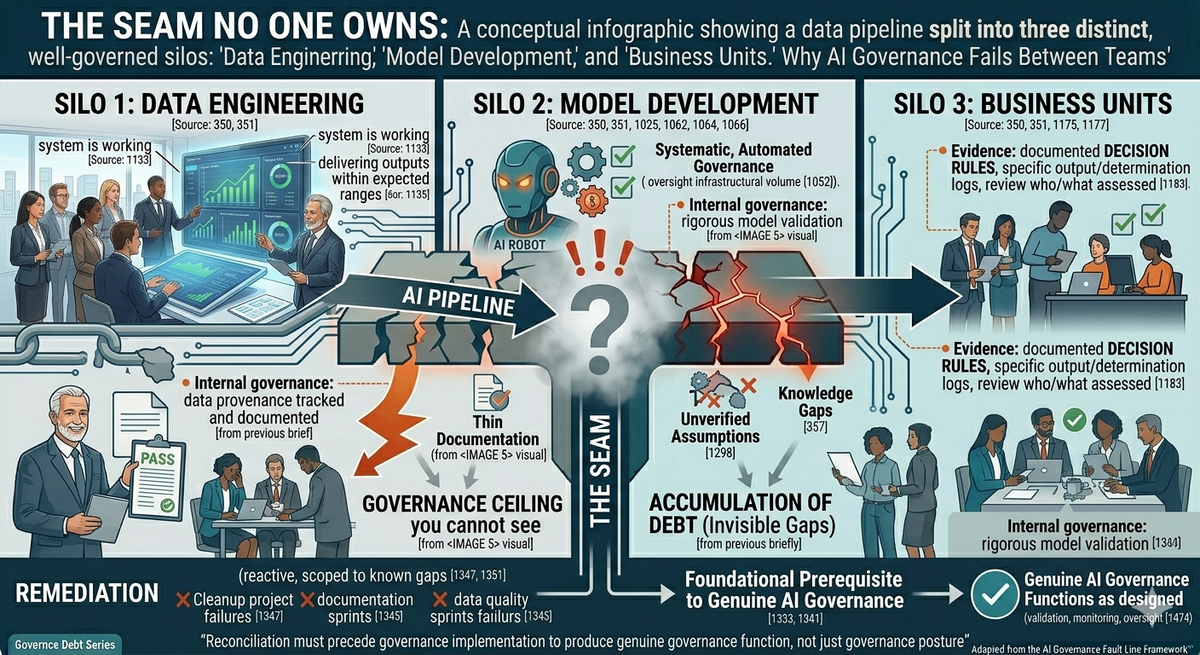
Every organization has a version of the same structural reality: work moves between teams, and the boundaries where that movement happens are where governance most reliably breaks down. Not because the teams on either side are ungoverned, most are, within their own scope, but because the boundary itself belongs to no one. It is the space between accountability structures, and in that space, assumptions accumulate, documentation thins, and the coherent chain of understanding that governance requires develops its most significant fractures.
This is not a failure of any individual team. Each team typically governs what it controls with reasonable consistency. The data engineering team maintains its pipelines. The analytics team validates its models. The risk function monitors its defined perimeter. The fracture does not appear within these domains. It appears at the point of transfer, where data, decisions, or processes cross from one team's ownership into another's, and where the receiving team's understanding of what it has received is assumed rather than verified.
Governance Debt, as the preceding articles have established, accumulates through rational decisions made inside systems that never demanded otherwise. The hand-off fracture is where that debt concentrates most densely, because hand-offs are precisely the moments where the cost of full verification feels highest and the pressure to proceed feels most immediate.
What a Hand-Off Actually Transfers
When one team passes data, a process, or a system component to another, the formal transfer is typically well defined. There is a dataset, an API, a report, a feed. What is rarely transferred with the same fidelity is the surrounding understanding, the context, the caveats, the known anomalies, the decisions that shaped what is being handed over.
The delivering team knows things about what it is passing that are not in the documentation. It knows which fields are reliable and which carry known quirks that the team has learned to manage. It knows the edge cases that the system handles imperfectly and the workarounds that have become standard practice. It knows the original design intent and the ways in which actual implementation diverged from it. Some of this knowledge is in documentation. Most of it is in the heads of the people who built and maintained the system, transferred imperfectly through conversations, partially captured in tickets and comments, and largely invisible to the receiving team as formal, verifiable fact.
The receiving team inherits the output and the partial account. It builds on what it receives, extending the system, adding its own layer of transformation and logic. The caveats it did not fully receive become assumptions it does not know it is making. The anomalies it was not fully briefed on become inconsistencies it cannot explain when they surface later. The governance chain, which requires verifiable understanding at every step, has its first significant break at precisely this point.
The Assumption of Upstream Reliability
There is a specific failure mode at hand-off boundaries that deserves direct examination, because it is nearly universal and almost always invisible until it causes a problem. It is the assumption of upstream reliability.
When a team receives data or a system component from another team, it typically validates that what it received conforms to the expected format and falls within expected parameters. What it rarely validates is whether the upstream system that produced it is itself operating on well-understood and well-documented foundations. The receiving team tests the output. It does not audit the process that generated it.
This is rational. Auditing the upstream process is expensive, requires access and cooperation that may not be readily available, and falls outside the receiving team's defined scope. The upstream team is accountable for its own domain. The receiving team is accountable for its own. The assumption is that the upstream team's accountability is functioning and that the output it delivers can therefore be trusted.
In many cases, that assumption holds well enough. In many others, it holds only because no one has yet encountered the specific condition under which it fails. The upstream system may be carrying its own undocumented anomalies. Its transformation logic may have evolved in ways that are not reflected in current documentation. Its reliability may be contingent on conditions that are not visible to the downstream team and not formally documented anywhere.
When the assumption of upstream reliability is wrong, the error propagates downstream silently. The receiving team builds on a foundation it believes to be solid. Each subsequent team does the same. By the time the inconsistency surfaces, in an audit, in a challenged decision, in an AI output that cannot be explained, it has passed through multiple layers of transformation, and tracing it back to its origin requires traversing a chain of hand-offs, each of which transferred partial understanding and compounded the gap.
Where Ownership Goes Ambiguous
The hand-off fracture is not only a problem of knowledge transfer. It is also a problem of ownership, specifically, the systematic ambiguity about who is responsible for what at the point where one team's scope ends and another's begins.
Most organizational accountability structures are designed around domains, not chains. A team is responsible for a system, a process, or a dataset. Its accountability is defined by what it owns, not by what flows through it or what its outputs enable downstream. This design works reasonably well within domains. It breaks reliably at boundaries.
Consider a data feed that originates in a source system, is transformed by a data engineering team, is consumed by an analytics function, and ultimately informs a model that produces outputs used by a business unit. Each team in that chain has defined accountability for its own component. No team has accountability for the integrity of the full chain. If a question arises about whether the final output accurately reflects reality, it must be traced back through each hand-off, and at each hand-off, the question of who is responsible for the gap between what was delivered and what was understood becomes genuinely ambiguous.
The source system team delivered what it was designed to deliver. The data engineering team transformed it according to its specifications. The analytics function built on what it received. The business unit used what the model produced. Each team can demonstrate that it operated within its defined scope. None of them is straightforwardly accountable for the gap that exists between the beginning and the end of the chain, because that gap did not occur within any single team's domain. It occurred in the spaces between them.
This ambiguity is not accidental. It is a structural feature of how accountability is typically assigned in complex organizations. It is also precisely the condition that makes Governance Debt hardest to address, because addressing it requires someone to own something that the organizational structure has not assigned to anyone.
The Compounding Effect Across Layers
A single hand-off fracture is a manageable problem. It can, in principle, be identified and addressed by the teams on either side of it. What makes the hand-off fracture a systemic governance problem rather than an operational inconvenience is the compounding effect that occurs when fractures accumulate across multiple layers.
Enterprise systems are not two-team chains. They are networks of dependencies, with data and processes moving through multiple teams, multiple transformations, and multiple ownership boundaries before producing the outputs that AI systems operate on and that governance frameworks are meant to oversee. Each boundary in that network is a potential fracture point. Each fracture point is a location where documented understanding thins, where assumptions substitute for verified knowledge, and where the chain of accountability becomes ambiguous.
The cumulative effect is a system that is locally governed at each node but ungoverned across the full chain. Each team can account for its own component. No team, and no governance function, can account for the whole. The visibility that exists within domains does not aggregate into visibility across them. It stops at the boundary, which is precisely where the next team's assumptions begin.
When AI is introduced into this environment, it does not encounter a governed system with isolated gaps. It encounters a network of governed domains connected by ungoverned seams. Its outputs are shaped by the full chain, including the fractures. Its explainability is bounded by the weakest link in a chain of hand-offs, none of which was designed with end-to-end accountability in mind.
The Boundary No Governance Framework Crosses
There is a structural reason why standard governance frameworks do not resolve the hand-off fracture, and it is important to name it directly. Governance frameworks are typically scoped to systems, processes, or functions. They define requirements, controls, and accountability within a defined domain. They are not, by design, scoped to the boundaries between domains, because those boundaries do not appear on organizational charts, are not owned by any function, and are not visible to any single governance body operating within its assigned perimeter.
The result is that governance frameworks can be fully implemented within every team in the chain and the hand-off fractures can persist entirely unaddressed. Each team passes its audit. Each function demonstrates its controls. The seams between them remain ungoverned not because governance failed within any domain but because no governance framework was ever scoped to the boundary itself.
This is the structural condition that the next articles in this series examine directly: the absence of any function with the authority, visibility, and mandate to govern the full chain rather than its constituent parts. The hand-off fracture is where Governance Debt concentrates. The accountability gap is why it stays there.
What the Fracture Looks Like When It Matters
The hand-off fracture is invisible in normal operations. Systems deliver outputs. Teams meet their obligations. Audits are navigated with sufficient documentation to satisfy the questions asked. The fracture becomes visible under a specific condition: when a consequential decision must be explained fully, end to end, with verifiable evidence at every step.
At that moment, the chain must be traversed. Each team must account for its component. Each hand-off must be reconstructed. And at each boundary, the limitations of what was transferred, the knowledge that did not make it into documentation, the assumptions that were never verified, the anomalies that were known to the delivering team and unknown to the receiving one, become the points at which the explanation weakens or breaks.
The organization does not discover that it has a governance problem. It discovers that the governance problem has a specific architecture: it is located at the seams, it spans multiple teams, and it cannot be resolved by any single team acting within its own domain. That discovery, made under scrutiny and time pressure, is the moment the cost of the hand-off fracture becomes impossible to defer.
The articles that follow examine why that cost is so difficult to assign, and why the organizational structures that would be required to address it have, in most cases, never been built.
This article is part of the Governance Debt Framework™, a structured exploration of how modern organizations accumulate invisible risk as decisions, systems, and responsibilities drift out of alignment. The goal is to both diagnose the problem and provide a clear lens for understanding what happens inside complex organizations, and develop a path toward restoring systems that can explain, justify, and sustain the decisions they produce.