The Illusion of Compliance: How Real Governance Produces False Assurance
The organizations that feel most governed are sometimes the ones most in need of asking whether their governance frameworks are reaching the systems beneath them.

The Governed Organization
Most serious organizations are genuinely governed. They have policies specifying how systems should be built, validated, and maintained. They have frameworks defining the controls required at each stage of development and deployment. They have oversight committees that review material decisions, compliance functions that monitor adherence to established standards, and audit processes designed to verify that what is supposed to happen is happening. They invest in these structures deliberately, staff them with capable people, and treat them as evidence of organizational maturity.
The governance is real. The documentation is genuine. The people responsible for it are doing their jobs. And yet, in most of these organizations, a gap exists — specific, significant, and largely invisible to the structures designed to detect it — between what the governance asserts about the systems it governs and what those systems could actually demonstrate about themselves if the assertion were tested directly.
This gap is not the product of dishonesty or negligence. It is the product of something more fundamental: governance structures designed to confirm that processes were followed, extended as evidence that the systems those processes govern are sound. Process adherence and foundational soundness are related. They are not the same. The distance between them is where the illusion of compliance lives.
What Governance Was Designed to Do
To understand why this gap exists, it helps to understand what governance frameworks were originally designed to accomplish, because they were built for a specific purpose that has not kept pace with the complexity of the systems they are now asked to govern.
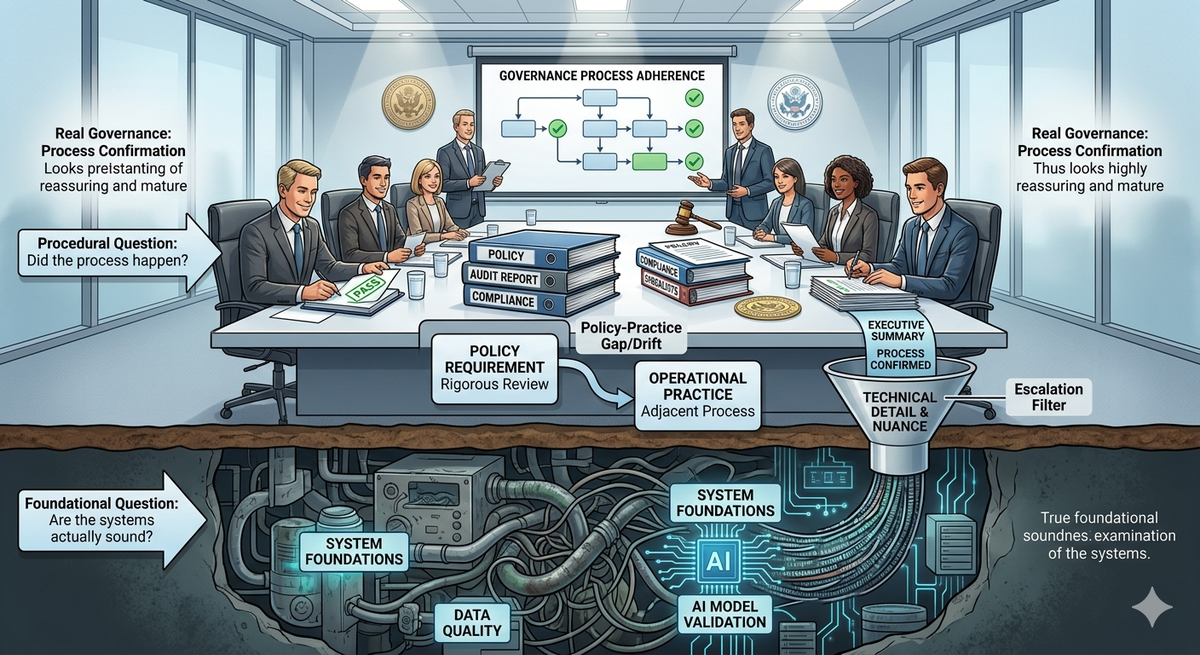
Governance frameworks in most organizations were built to answer a procedural question: did the right things happen, in the right order, with the right sign-offs, at the right points in the process? Did the model go through validation before deployment? Did the data quality review occur before the data was used? Did the appropriate committee approve the system before it went into production? These are reasonable questions. They establish that an organization has defined standards and that people are following them. They produce documentation that demonstrates process discipline and creates an audit trail that governance activity occurred.
What they do not do, and were not designed to do, is verify whether the validation was rigorous enough to catch what it needed to catch; whether the data quality review examined the dimensions of quality that actually matter for the use case; or whether the committee's approval was based on genuine understanding of what was being approved, or merely on confidence that the process leading to it had been correctly followed. The procedural question is answerable through documentation. The foundational question requires something different: direct examination of the system's actual condition, rather than confirmation that the process surrounding it was completed.
Most governance frameworks have become very good at answering the procedural question. The foundational question — whether the systems those frameworks govern are actually sound, actually understood, actually capable of accounting for themselves under scrutiny — is the question that the procedural answer has come to substitute for without being recognized as a substitute.
The Policy-Practice Gap
The first mechanism through which the illusion of compliance is constructed is the distance between what governance policy requires and what operationally occurs, a distance maintained not through deliberate non-compliance but through the natural drift that takes place between policy and practice in any complex organization.
Governance policies are written at a level of abstraction necessary for them to apply across a range of systems, contexts, and operational conditions. They specify requirements in terms general enough to be broadly applicable. The people responsible for implementing those requirements in specific operational contexts interpret them through the lens of what is feasible, what is standard practice in their domain, and what similar reviews have looked like in the past. The people responsible for reviewing compliance confirm that something happened, that a review occurred, that documentation was produced, that a checklist was completed, without examining whether what happened corresponds to what the policy was designed to ensure.
The result is a policy that says one thing, a practice that does something adjacent to it, and a compliance review that confirms the practice occurred without assessing the distance between practice and policy intent. None of the people involved is acting in bad faith. The policy writers could not anticipate every operational context. The implementers are navigating real constraints. The reviewers are confirming what they have been given the tools to confirm. The gap is maintained by the ordinary operation of a system designed to move documentation rather than to verify substance.
This gap is not dramatic. It does not produce obvious failures. It produces something subtler: governance documentation that accurately reflects a practice adjacent to, but not identical with, the policy it is meant to implement, and compliance confirmation that treats that documentation as evidence of policy adherence when it is evidence of practice documentation. Over time, the practice becomes the standard. The distance between it and the policy intent becomes the normal operating condition. The governance structures confirm the practice with the same confidence they would confirm the policy, because the documentation they examine no longer distinguishes between them.
The Audit Confirmation Problem
The second mechanism is the way governance review processes are designed to confirm the presence of documented activity rather than to assess whether that activity produced what governance was designed to ensure.
Consider what a standard governance audit of an AI system actually examines. It confirms that a model validation was conducted, that the validation report exists, was completed by the appropriate function, and was reviewed by the appropriate committee. It confirms that a data quality assessment occurred, that the assessment is documented, covers the required dimensions, and was signed off by someone with the appropriate authority. It confirms that change management processes were followed when the system was modified, that changes were documented, reviewed, and approved through the correct channels.
Each of these confirmations is genuine. The validation report exists. The data quality assessment is documented. The change management process was followed. What the audit has confirmed is that documentation of governance activity exists. What it has not confirmed, what it was not designed to examine, is whether the validation was rigorous enough to catch the specific failure modes relevant to this system's use case; whether the data quality assessment examined the dimensions of quality that actually affect the system's outputs; or whether the change management review was conducted by people with sufficient understanding of the system's foundations to assess what the changes implied.
The distinction is between confirming process and verifying outcome. Process confirmation is what audits do efficiently and consistently. Outcome verification requires something more demanding: direct assessment of whether the process produced the result it was designed to produce, which requires both understanding what the right result looks like and the technical depth to evaluate whether it was achieved. Most governance review processes are staffed and scoped for process confirmation. Outcome verification is what process confirmation is assumed to have ensured — an assumption the documentation supports, and that direct examination of the system's actual condition would sometimes contradict.
The Escalation Filter
The third mechanism operates at the intersection of organizational hierarchy and information flow: the progressive transformation of system-condition information as it travels upward through governance structures toward the people with the authority and responsibility to act on it.
At the system level, where data engineers, model developers, and technical staff work directly with the system, there is generally the most accurate picture of its actual condition. These are the people who know which data sources have known quality issues the team has learned to work around; which validation results were stronger and which were weaker; which assumptions are embedded in the system's design that were never formally documented because they were obvious at the time of implementation. This knowledge is real, specific, and often not fully captured in the documentation governance review examines.
As information about the system moves upward, through team leads, function heads, governance committees, and executive summaries, it is necessarily compressed. The nuances the technical team holds are not transmittable in a summary report. The known quality issues the team navigates daily do not appear in governance documentation as issues, because the team manages them operationally and they do not trigger the thresholds that would classify them as reportable concerns. The weaker validation results are contextualized alongside the stronger ones in an aggregate picture reflecting overall performance. The undocumented assumptions are not represented at all, because they were never formalized.
The people producing these summaries are not misrepresenting their systems. They are presenting them accurately within the constraints of what summary reporting can convey. The people receiving the summaries are not being deceived. They are receiving the information the reporting structure was designed to deliver. The escalation filter is not a mechanism of dishonesty. It is a mechanism of compression that consistently produces a picture of organizational systems that is more confident at the top of the governance structure than the underlying operational reality supports, a picture that reflects the governance documentation accurately while the gap between the documentation and the system's actual condition remains at the level where the people who understand it are not the people with the authority to address it.
The Compliance Culture Paradox
There is a specific and important irony embedded in the dynamics this article has described, and it deserves direct examination because it challenges an assumption that most governance-conscious organizations hold about themselves.
Organizations that have invested most heavily in governance infrastructure, those with the most developed policy frameworks, the most active oversight committees, the most experienced compliance functions, and the most thorough audit processes, are not necessarily the organizations in which the gap between governance as documented and governance as practiced is smallest. In some cases, they are the organizations in which it is most thoroughly obscured.
The investment in governance infrastructure produces confidence: the institutional sense that governance is being done, that the organization takes its responsibilities seriously, that capable people occupy governance roles, that the frameworks in place are comprehensive. That confidence is not unwarranted. The governance activity is real. The investment is genuine. But confidence in governance activity is not the same as verified governance soundness. In organizations where that confidence is high, the urgency of examining whether the activity is actually reaching the systems it governs is correspondingly low.
The compliance culture that produces the most sophisticated documentation of governance processes is sometimes the culture that has traveled furthest from the question of whether those processes are producing the foundational soundness the documentation implies. Not through any failure of intent, but through the institutional dynamic Article 1 established at the individual level: systems that appear to be working well, including governance systems, earn trust that substitutes for examination of whether the appearance reflects the reality.
The organizations that feel most governed are sometimes the ones most in need of asking whether their governance frameworks are reaching the systems beneath them. Not as an accusation. As a diagnostic question that the governance activity itself has made feel unnecessary.
How the Gap Persists
The gap between governance as documented and governance as practiced did not arrive fully formed. It was built gradually through the accumulation of individually rational choices made by capable people inside organizations that rewarded what their governance structures were designed to measure rather than what those structures were designed to ensure.
The policy was written at the level of abstraction that made it broadly applicable. The implementation interpreted it through the lens of what was operationally feasible. The compliance review confirmed what the documentation demonstrated. The escalation filter compressed the nuance that would have complicated the governance picture. Each decision was defensible given the constraints of the person making it. None was made with the intent to create a gap. The gap emerged from their aggregation.
Understanding this is the key to understanding why the gap is so persistent and so difficult to address through governance framework enhancement alone. The gap is not the product of bad governance. It is the product of governance that was designed for one task, confirming process adherence, operating in an environment that requires something it was not designed to supply: verified foundational soundness of the systems it governs. Redesigning the framework does not close the gap if the decisions that maintain it continue to be made the way they have always been made, by capable people responding rationally to the incentives and constraints they inhabit.
That is the question the next article takes up directly: not the architecture of the gap, but the mechanism of its construction, the specific incentive structures, organizational dynamics, and professional pressures that cause capable people to make the decisions that build and maintain it, one rational choice at a time.
This article is part of the Governance Debt Framework™, a structured exploration of how modern organizations accumulate invisible risk as decisions, systems, and responsibilities drift out of alignment. The goal is to both diagnose the problem and provide a clear lens for understanding what happens inside complex organizations, and develop a path toward restoring systems that can explain, justify, and sustain the decisions they produce.