The Hidden Timeline of Governance Debt
The clock has been running. It has not been showing its face.

The Clock That Runs Without Showing Its Face
Every organization carrying Governance Debt is also carrying something it cannot see: a timeline. The debt did not appear at a fixed point and remain static, waiting to be discovered and addressed. It has been accumulating since the first decision traded future explainability for present delivery, and it has been compounding ever since — silently, invisibly, and with increasing consequence for every year that passes without remediation.
The compounding is the part that is almost never understood until it is encountered directly. Organizations that recognize they have Governance Debt tend to treat it as a documentation backlog, a defined set of gaps that can be catalogued, prioritized, and closed through sufficient effort and investment. What they discover, when they begin that effort in earnest, is that the debt is not a backlog. It is a condition that has been growing into the structure of their systems for years, and in many cases for decades, and that the passage of time has made it categorically more difficult to address than it would have been at any earlier point.
The clock has been running. It has not been showing its face. And the distance between where the hands are now and where most organizations believe them to be is one of the most consequential miscalculations in enterprise risk management.
How Debt Compounds Over Time
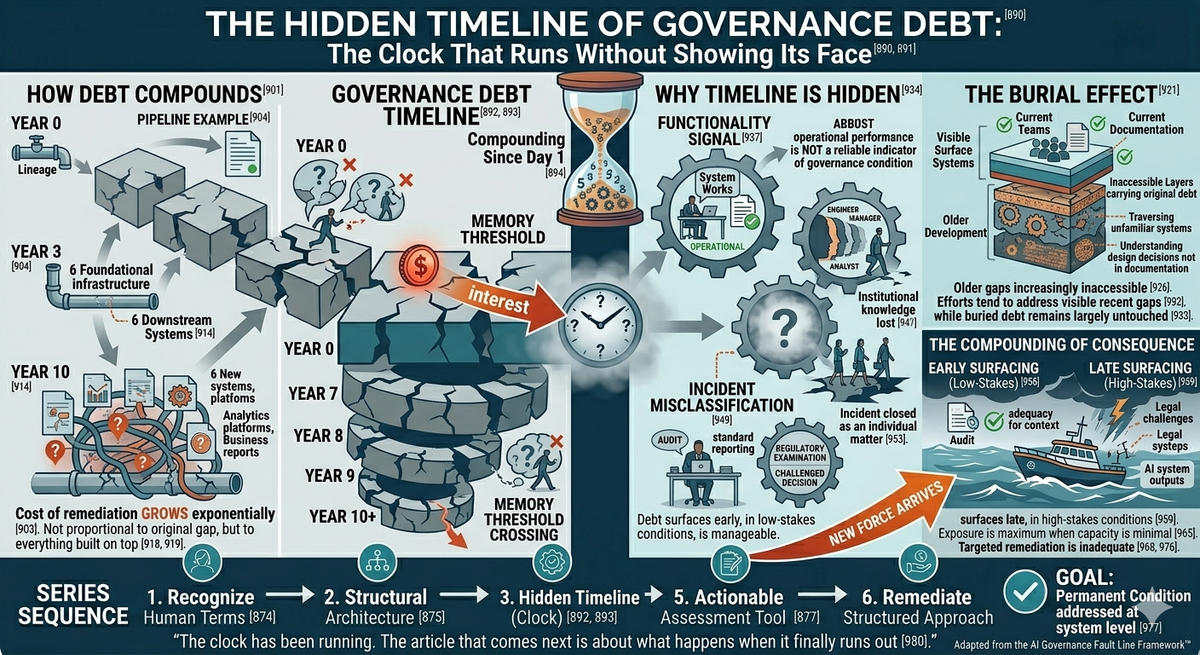
Financial debt compounds because interest accrues on the outstanding balance, increasing the total obligation with each period that passes without repayment. Governance Debt compounds through a different mechanism, but the structural logic is similar: the cost of remediation grows not linearly but exponentially, as each layer of development built on top of unresolved debt inherits that debt and extends it.
Consider a data pipeline built with incomplete lineage documentation. In the year it is built, the gap is relatively contained. The people who built it are present. The design decisions are recent enough to be recoverable through conversation if not through documentation. The systems downstream of it are few and the dependencies are relatively simple. Closing the gap at this point requires effort, but the effort is bounded and the evidence required to close it is mostly still accessible.
Three years later, the pipeline has become foundational infrastructure. Six downstream systems depend on it. Two of them have been built by teams that assumed its outputs were fully validated and documented. One of those systems feeds an analytics platform that informs quarterly business decisions. The people who built the original pipeline have moved on. The design decisions that were recoverable through conversation are now recoverable only through incomplete documentation and the partial memories of people who were adjacent to the original work but not central to it.
The gap in lineage documentation has not stayed the same size. It has grown into the structure of six downstream systems, each of which has its own documentation gaps, its own hand-off fractures, and its own inherited assumptions about the reliability of what it receives. Closing the original gap now requires not just documenting the pipeline but tracing its implications through every system built on top of it, validating assumptions that were never stated, reconstructing design decisions that were never documented, and mapping dependencies that were never formally recorded.
This is what compounding looks like in Governance Debt. The original gap does not grow in isolation. It becomes the foundation for subsequent work, and the subsequent work inherits and amplifies it. By the time the gap is recognized as a problem requiring remediation, the remediation required is not proportional to the original gap. It is proportional to everything built on top of it since.
The Burial Effect
There is a specific dynamic in the compounding of Governance Debt that deserves its own examination: the burial effect. As systems are built on top of unresolved debt, the original gaps do not merely persist. They are buried beneath layers of subsequent development that make them progressively harder to locate, characterize, and address.
The burial happens because each new layer of development is built with its own assumptions, its own documentation practices, and its own operational logic. Those layers become the visible surface of the system. They are what current teams interact with, what current documentation describes, and what current governance frameworks are applied to. The layers beneath, the ones carrying the original debt, are not invisible, but they are increasingly inaccessible. They require traversing systems that current teams did not build, understanding design decisions that current documentation does not capture, and engaging with organizational history that has been partially lost to time and turnover.
The practical consequence is that Governance Debt becomes harder to see the older it is. Recent gaps are relatively accessible because the evidence required to characterize them is recent. Older gaps are buried under years of subsequent development and are visible only to people with the organizational history, the technical access, and the investigative mandate to look beneath the surface. Most organizations have none of these things consistently available, which means the oldest and most deeply embedded debt, the debt that has had the most time to compound and the most subsequent development built on top of it, is precisely the debt that is hardest to find.
When organizations undertake governance remediation efforts, they tend to address what is visible: recent gaps, current documentation deficiencies, newly identified hand-off fractures. The buried debt, which is older, more deeply embedded, and more consequential because more has been built on top of it, remains largely untouched, not because it is being deliberately ignored, but because the effort required to surface it exceeds what any remediation initiative is typically scoped or resourced to undertake.
Why the Timeline Is Hidden
If Governance Debt compounds and buries itself over time, the question becomes: why don't organizations see it happening? The answer has three components, each of which reinforces the others.
The first is the functionality signal. Systems that carry Governance Debt continue, in most cases, to function. They produce outputs that are used, decisions that are implemented, reports that are acted upon. The operational performance of a system is not a reliable indicator of its governance condition. A pipeline with incomplete lineage documentation delivers data with the same apparent reliability as one that is fully documented. A decision process with unverified assumptions produces outputs that look the same as one whose assumptions have been rigorously validated. The system works, which removes the signal that would otherwise prompt investigation into whether it is understood.
The second is the memory threshold. Governance Debt crosses organizational memory thresholds as the people who made the original decisions move on. This happens gradually and without announcement. The engineer who knew why the transformation was designed the way it was leaves the organization. The manager who understood the original design constraints moves to a different role. The analyst who was aware of the data quality issue that was acknowledged and set aside retires. With each departure, a portion of the institutional knowledge that partially compensated for the documentation gap is lost. The gap itself does not change. The organization's ability to navigate it does, and it declines in ways that are not tracked, not measured, and not visible until the navigation is attempted and fails.
The third is the incident misclassification problem. The moments when Governance Debt surfaces, an audit that cannot be fully satisfied, a regulatory examination that exposes documentation gaps, a challenged decision that cannot be traced end to end, are almost universally treated as isolated incidents. The organization responds to the specific question that was asked, produces the best account it can construct, and implements targeted remediation for the specific gap that was exposed. What it does not do is treat the incident as evidence of a cumulative condition with a long timeline behind it.
This misclassification is consequential because it prevents the organization from ever developing an accurate picture of how much debt it is carrying or how long it has been accumulating. Each incident is closed as an individual matter. The pattern across incidents, which would reveal the systemic condition, is never assembled. The timeline remains hidden not because it is inaccessible but because no one is looking at the incidents together and asking what they collectively indicate about the state of the system as a whole.
The Compounding of Consequence
The compounding of Governance Debt over time is not only a compounding of remediation cost. It is also a compounding of consequence, the potential impact of the debt when it surfaces under conditions that the organization did not choose and cannot control.
Debt that surfaces early, in low-stakes conditions, is manageable. The gap is identified, the explanation is incomplete but adequate for the context, and the remediation is targeted and contained. Debt that surfaces late, in high-stakes conditions, is a different category of problem entirely. The gap is larger because more has been built on top of it. The explanation is more incomplete because more time has passed and more institutional memory has been lost. The remediation is more expensive because the debt is more deeply embedded. And the stakes are higher because the conditions that surfaced it, a regulatory examination, a legal challenge, a consequential AI output that cannot be explained, are not ones that allow for a partial account or a promise of future remediation.
This is the pattern that the hidden timeline produces: debt accumulates in low-visibility conditions, compounds in low-consequence periods, and surfaces in high-stakes moments. The organization encounters its maximum exposure at precisely the moment when its capacity to manage that exposure is most constrained, when external pressure is highest, when time for remediation is shortest, and when the cost of an inadequate explanation is greatest.
The surfacing is not random. It follows the logic of the timeline with a consistency that should, in retrospect, be recognizable. Audits impose explainability requirements. Regulatory examinations demand documentation. Legal challenges require reconstruction. These events have always existed. What has changed, and what the next article in this series addresses directly, is that a new force has entered the environment, one that does not impose explainability requirements episodically and predictably but continuously and at a scale that makes the management of Governance Debt through reactive, incident-by-incident responses permanently inadequate.
The Moment Episodic Becomes Permanent
For most of the timeline of Governance Debt accumulation, organizations have been able to manage its surfacing through reactive responses to discrete events. An audit arrives, the organization responds, targeted gaps are addressed, and operations resume. The debt continues to accumulate between events, but the events themselves are spaced and bounded in ways that make the reactive model viable, if not sustainable.
That model depends on one condition: that the pressure to explain systems is episodic rather than continuous. When explanation is required only at specific moments, the audit, the examination, the challenge, the organization can direct focused effort at those moments and manage the gaps in between. When explanation is required continuously, at scale, across every consequential decision a system produces, the reactive model has no adequate response. The gap between what the system can explain and what it is being asked to explain is no longer a gap that can be closed through targeted remediation at discrete intervals. It is a permanent condition that must be addressed at the level of the system itself.
The force that makes the pressure continuous is the subject of the article that follows. What this article establishes is the condition that force arrives into: systems carrying decades of compounded, buried, misclassified Governance Debt, in organizations that have consistently underestimated its timeline, misread its surfacing as isolated incidents, and deferred its remediation to a convenient moment that the compounding has made progressively less attainable.
The clock has been running. The article that comes next is about what happens when it finally runs out.
This article is part of the Governance Debt Framework™, a structured exploration of how modern organizations accumulate invisible risk as decisions, systems, and responsibilities drift out of alignment. The goal is to both diagnose the problem and provide a clear lens for understanding what happens inside complex organizations, and develop a path toward restoring systems that can explain, justify, and sustain the decisions they produce.