The Cost of Governance Debt: Why It Never Shows Up Until It Does
Your AI systems are accumulating costs your CFO hasn't calculated.

The Bill That Arrives Without Warning
Every organization carrying Governance Debt is also carrying a financial exposure it has not calculated, an operational drag it has not measured, and an opportunity cost it has not named. These costs are real. They are accumulating. And they are almost certainly not appearing anywhere in your organization's budgets, risk registers, or board reporting, not because they are small, but because the accounting systems organizations use to track cost were not designed to capture liabilities that have not yet materialized as incidents.
This is the defining characteristic of Governance Debt costs: they are invisible in the periods when they are accumulating and sudden when they arrive. They do not build gradually toward a threshold that triggers organizational response. They exist below the surface of normal operations, generating no alerts and no line items, until the specific condition that makes them visible, a regulatory examination, an operational failure, a legal challenge, a consequential AI output that cannot be explained, arrives without warning and makes them completely, irreversibly, and expensively visible all at once.
The audit test in the preceding article located your governance ceiling. This article tells you what it costs to have one. Not in abstract risk terms. In the specific financial, regulatory, and operational terms that your board, your CFO, your chief risk officer, and your regulators understand and respond to.
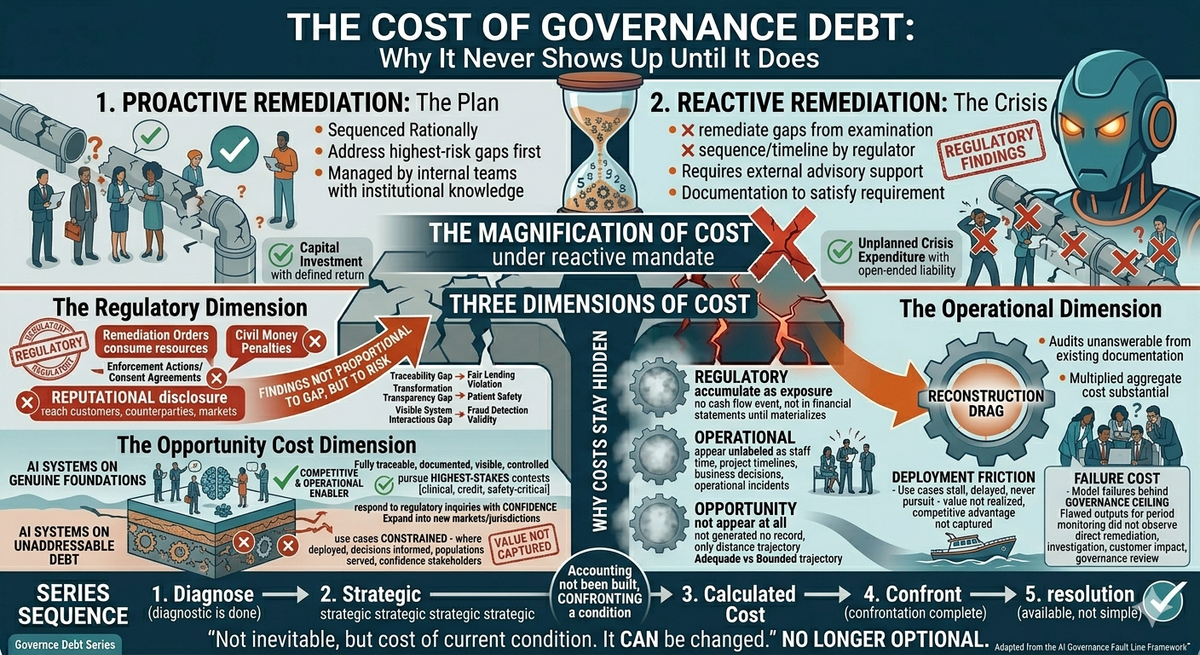
The costs operate across three dimensions. Each is present in your organization right now, whether or not it appears in any report you have seen.
The Regulatory Dimension: The Cost of the Examination You Cannot Pass
Regulatory cost is the dimension most immediately legible to organizational leadership, because it arrives with the most visible and attributable consequences. It is also the dimension most consistently underestimated, because organizations tend to calculate it as the cost of a specific enforcement action rather than as the full cost of the condition that made the enforcement action possible.
The mechanism by which Governance Debt produces regulatory cost is specific and worth tracing precisely, because understanding the mechanism is what allows you to calculate the exposure before it materializes rather than after.
A regulatory examination of an AI system does not begin with the model. It begins with a decision, a specific, consequential output that the regulator selects for end-to-end review. The examination follows the chain: data origin, transformation logic, system interactions, model inputs, validation basis, output generation, downstream use. At each stage, the examiner requests documentation. Not a narrative. Not a process description. The documentation that existed at the time the decision was made, the contemporaneous evidence that the chain operated as the organization claims it operated.
If your organization passed the audit test in article ten with complete documentation at every stage, this examination proceeds without incident. If it did not, if your explanation relied at any stage on inference, institutional memory, reconstructed accounts, or general process documentation rather than specific instance evidence, the examination finds what the audit test found. And what the examination finds becomes the basis for its findings.
The findings that follow foundational gaps are not proportional to the gap. They are proportional to the risk the gap represents in the context of the decisions the AI system was making while the gap existed. A traceability gap in an AI system making credit determinations is not a documentation deficiency. It is a potential fair lending violation, a potential consumer protection failure, and a potential systemic risk concern, depending on the scale at which the system was operating and the population it was affecting. A transformation transparency gap in a clinical AI system is not a record-keeping lapse. It is a patient safety question. A visible system interactions gap in a fraud detection model is not an architectural oversight. It is a question about whether the model's outputs were valid across the full range of conditions in which they were used.
The regulatory consequences that attach to these findings range across a spectrum that organizations consistently underestimate when they calculate their exposure in advance. Remediation orders require the organization to close specific gaps under regulatory supervision, on a timeline the regulator sets, with progress reporting the regulator defines. They are expensive not primarily because of the remediation itself, though foundational remediation under regulatory mandate is significantly more expensive than proactive remediation, for reasons addressed below, but because of the organizational resources consumed by regulatory management: the legal coordination, the external advisory support, the internal working groups, the documentation production, and the senior leadership attention that a remediation order under active regulatory supervision demands continuously until the order is closed.
Enforcement actions, consent agreements, and civil money penalties represent the further end of the spectrum, reserved for situations where the gap was material, the harm was demonstrable, or the organization's response to preliminary findings was inadequate. The financial cost of these outcomes is the one that appears most clearly in board risk discussions, but it is not the largest cost for most organizations. The largest cost is reputational, the public disclosure of a finding that the organization's AI systems were operating without adequate foundational governance, in a regulatory environment that has made AI accountability a matter of public and political attention. That disclosure does not stay in the regulatory domain. It reaches customers, counterparties, employees, and markets, and its cost in those domains is neither bounded nor predictable.
The cost of proactive remediation, addressing foundational gaps before a regulatory examination, on your organization's timeline, with your organization's resources, and without external scrutiny of the process, is a fraction of the cost of reactive remediation under regulatory mandate. The fraction varies by context, but the structural reasons for the difference are consistent. Proactive remediation can be sequenced rationally, addressing the highest-risk gaps first and building foundational capacity progressively. Reactive remediation must address whatever gaps the examination identified, in the order and on the timeline the regulator specifies, regardless of whether that sequence is operationally optimal. Proactive remediation is managed by internal teams with institutional knowledge. Reactive remediation typically requires external advisory support, because the internal teams are simultaneously managing the regulatory relationship, responding to information requests, and continuing to operate systems that are under examination. Proactive remediation produces documentation that becomes a permanent asset. Reactive remediation produces documentation that satisfies a regulatory requirement, under time pressure, with all the quality limitations that pressure imposes.
The difference in cost between these two paths is not a marginal consideration. For organizations with significant Governance Debt in AI systems operating at scale in regulated domains, it is the difference between a planned capital investment with a defined return and an unplanned crisis expenditure with an open-ended liability. Your organization is currently on one of these paths. Which one is determined by whether you address the foundational condition before the examination or after it.
The Operational Dimension: The Cost You Are Already Paying
The regulatory cost of Governance Debt is the cost that arrives suddenly and visibly. The operational cost is the cost your organization is already paying, continuously, without recognizing it as the cost of your foundational condition. It does not appear in any budget labeled Governance Debt. It appears, dispersed and unlabeled, across the operational budgets of every team that works around the consequences of inadequate foundations every day.
The first form of operational cost is reconstruction drag, the organizational effort consumed every time a question about a system or a decision requires assembling an answer that documented foundations would have made immediately retrievable. Every audit, internal or external, that your governance teams cannot answer from existing documentation requires a working group. Working groups consume the time of senior technical staff, governance personnel, data engineers, model developers, and business representatives who are pulled from their primary work to reconstruct accounts of systems and decisions that were not documented with sufficient specificity to be self-explaining.
The hours involved in a single reconstruction working group are significant. Multiplied across the number of audits, reviews, regulatory inquiries, internal escalations, and stakeholder questions your organization manages in a year, the aggregate cost is substantial. It is paid in the salaries of the people involved, the opportunity cost of the primary work they are not doing while they are reconstructing, and the quality degradation that reconstruction under time pressure produces relative to contemporaneous documentation. It is a cost your organization pays repeatedly, for the same foundational gaps, because working groups address the symptom, the specific question that requires answering, without addressing the condition that makes working groups necessary.
The second form of operational cost is deployment friction, the AI use cases that stall, the deployments that are delayed, and the capabilities that are never realized because the foundational conditions required to govern them responsibly cannot be established on the current foundation. This cost is particularly significant because it is entirely invisible in standard reporting. A delayed deployment appears, if it appears at all, as a project management issue. A stalled use case appears as a strategic decision that the business case did not support. A capability that was never pursued does not appear anywhere.
What these entries in your project history actually represent, in many cases, is the cost of Governance Debt imposing a ceiling on your AI ambition. The deployment was delayed because the AI governance committee could not approve a system whose data lineage could not be documented. The use case stalled because the legal review identified traceability requirements the current system architecture could not meet. The capability was never pursued because the team responsible for assessing its feasibility concluded, without labeling it as such, that the foundational conditions required to deploy it responsibly were too far from the current state to make the business case viable.
Every one of these outcomes has a cost. The delayed deployment's cost is the value that was not realized during the delay period. The stalled use case's cost is the competitive advantage that was not captured, the operational efficiency that was not achieved, or the risk reduction that was not realized. The capability that was never pursued has a cost that is impossible to calculate precisely and easy to dismiss for that reason, but it is real, and in aggregate, across all the AI value your organization has not been able to capture because its foundations could not support it, it may be the largest single cost of Governance Debt your organization is carrying.
The third form of operational cost is failure cost, the incidents that occur because the monitoring infrastructure could not see past the governance ceiling, and the model behavior that drifted, degraded, or produced systematically biased outputs without triggering the alerts that would have prompted intervention. Model failures that are caught early, by monitoring systems that can observe the full chain of the system's operation, are contained and correctable. Model failures that develop behind the governance ceiling, in the space between what the monitoring can see and what the system is actually doing, are not caught until their effects are visible in outcomes: customer complaints, operational anomalies, regulatory inquiries, or internal investigations.
By the time a model failure that developed behind the governance ceiling is visible in outcomes, it has been operating and producing flawed outputs for a period that your monitoring did not observe. The operational cost of that period includes the direct remediation of the specific failure, the investigation required to determine how long the failure was operating and what outputs it affected, the remediation of those affected outputs where remediation is possible, the customer or counterparty impact where it is not, and the governance review that follows to determine why the monitoring did not catch it. The answer to that last question, why the monitoring did not catch it, is always the same: the monitoring could not see past the governance ceiling. The foundational condition that the audit test identified is the condition that the failure exploited. The cost of the failure is the cost of carrying the ceiling that made it possible.
The Opportunity Cost Dimension: The Value of the Ceiling You Cannot See Past
The regulatory and operational costs of Governance Debt are costs of exposure and drag, things that your organization pays because of what the foundational condition risks and prevents. The opportunity cost dimension is different in kind: it is the value your organization cannot capture because the foundational conditions required to capture it do not exist.
AI governance, when it rests on genuine foundational conditions, is not only a risk management function. It is a competitive and operational enabler. Organizations whose AI systems are fully traceable, whose transformation logic is documented and auditable, and whose system interactions are visible and controlled can deploy AI in contexts that organizations without those conditions cannot enter. They can pursue AI use cases in the highest-stakes domains, clinical decision support, credit adjudication, regulatory compliance, safety-critical operations, where the explainability and accountability requirements are most stringent and where the potential value of AI is greatest. They can respond to regulatory inquiries about their AI systems with confidence rather than working groups. They can expand AI deployment into new markets and new jurisdictions with regulatory frameworks that demand demonstrated foundational governance, rather than being blocked by the inability to demonstrate what those frameworks require.
The ceiling that limits your governance reach does not only limit what your governance can oversee. It limits what your AI can do. Every AI use case your organization pursues on a foundation that cannot support genuine governance is a use case that is constrained, in where it can be deployed, in the decisions it can inform, in the populations it can serve, and in the confidence that organizational and regulatory stakeholders can place in its outputs. The value not captured in those constraints is the opportunity cost of Governance Debt, and it compounds with every AI use case your organization pursues and every year that the foundational condition remains unaddressed.
The organizations that will capture the greatest value from AI in the coming decade are not necessarily the ones with the most sophisticated models. They are the ones whose foundational governance conditions allow them to deploy sophisticated models in the contexts where they create the most value, and to do so with the confidence of their boards, the trust of their regulators, and the assurance of their customers that the systems making consequential determinations about them are genuinely understood and genuinely controlled.
Your organization's Governance Debt is the distance between where you are and where those organizations will be. Every year that distance persists, it costs more to close and captures less value in the closing.
Why the Costs Stay Hidden Until They Don't
The three dimensions of cost described in this article share a structural characteristic that explains why they do not appear in standard organizational reporting: they do not generate the signals that organizational monitoring systems are designed to detect.
Regulatory cost accumulates as exposure, as the growing gap between your foundational condition and the regulatory standard against which you will eventually be measured. Exposure does not generate a cash flow event. It does not appear in financial statements. It does not trigger a risk register entry until it materializes as an incident. It exists as a contingent liability whose magnitude is a function of the gap, the scale of the AI system operating on inadequate foundations, and the regulatory environment in which it operates, but none of those factors is being measured and aggregated in any report your leadership team reviews.
Operational cost accumulates as drag, as the working group hours, the delayed deployments, the stalled use cases, and the model failures that appear in organizational records under labels that do not identify them as Governance Debt costs. The working group hours appear as staff time. The delayed deployments appear as project timelines. The stalled use cases appear as business decisions. The model failures appear as operational incidents. No report assembles these entries under the label that explains what they have in common, because no one has been asked to produce that report, and producing it would require recognizing Governance Debt as a category of organizational cost in the first place.
Opportunity cost does not appear at all. What does not happen generates no record. The AI use cases not pursued, the markets not entered, the regulatory approvals not sought, the competitive positions not captured, these exist only as the distance between your organization's current AI trajectory and the trajectory that adequate foundational governance would have made possible. That distance is real. It is growing. It does not appear in any document your board has reviewed.
The costs stay hidden because the accounting for them has not been built, because building it requires naming Governance Debt as an organizational liability, and because naming it requires confronting a condition that has been accumulating for years without triggering the organizational response that accurate accounting would demand.
That confrontation is the work of this series. This article has named the costs in terms your organization can recognize and respond to. The confrontation phase is complete. The diagnostic is done. The ceiling has been located. The cost has been calculated.
What remains is the question your board, your CFO, your chief risk officer, and your operational leaders will ask when they have absorbed what this series has established: what do we do about it?
The costs described in this article are not the inevitable price of operating AI systems in complex organizations. They are the cost of the current condition. And the current condition can be changed, deliberately, sequentially, and with a clearer understanding of what the work requires than most remediation efforts have begun with.
That understanding is what the series delivers next. The resolution is not simple. But it is available. And given what it costs to defer it, it is no longer optional.
This article is part of the Governance Debt Framework™, a structured exploration of how modern organizations accumulate invisible risk as decisions, systems, and responsibilities drift out of alignment. The goal is to both diagnose the problem and provide a clear lens for understanding what happens inside complex organizations, and develop a path toward restoring systems that can explain, justify, and sustain the decisions they produce.