The Clause Your AI Vendor Hopes You Never Read
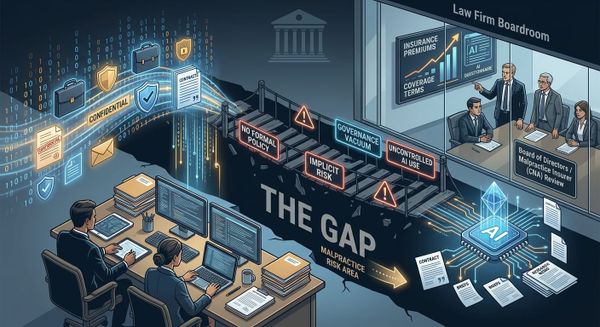
When it goes wrong, the vendor's position is protected and the attorney's isn't and that gap was written into the contract you signed

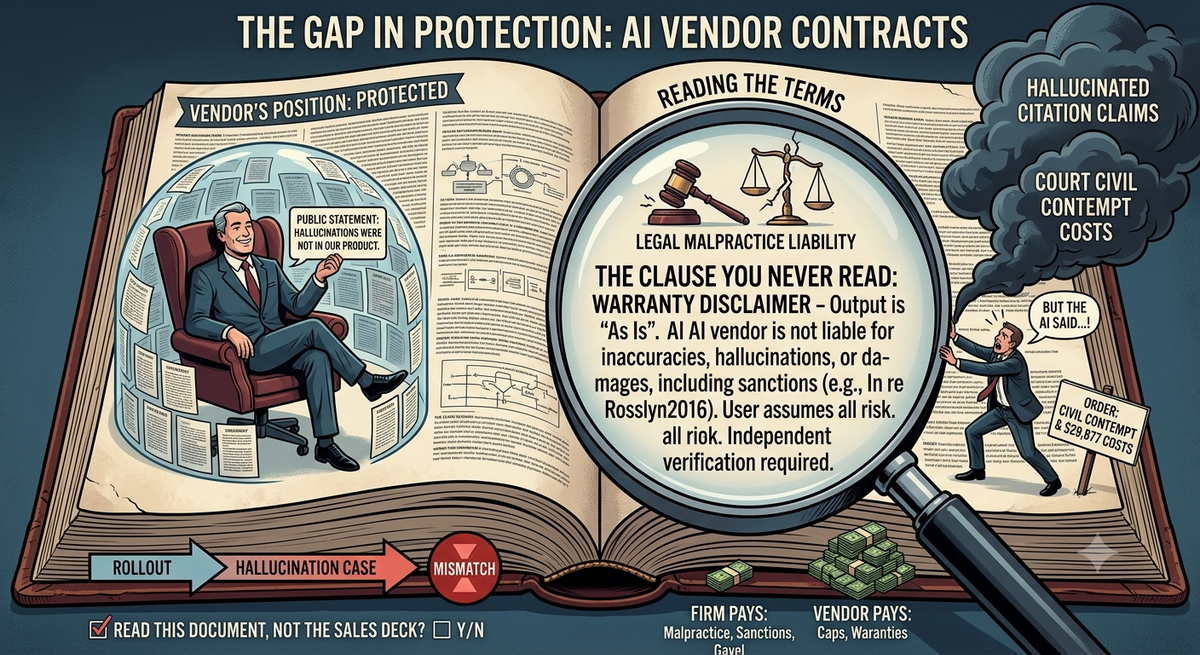
A bankruptcy attorney used Westlaw's AI research tool to prepare a discovery motion. Several of the citations in that motion turned out to be fabricated or misused — including one meant to anchor an attorney-client privilege argument. One supposedly supported limiting a Rule 2004 examination on the grounds of "disproportionate burdens on non-debtor third parties." The court found the opposite: the case actually rejected that argument. Another quote was attributed to In re Symington and simply didn't appear in that opinion. A third piece of phrasing, credited to two other cases, didn't exist in either one.
The court held the attorney in civil contempt and ordered $29,877 in costs. Then Thomson Reuters, the company behind Westlaw, made a public statement: none of the hallucinations originated in its product.
That's In re Rosslyn2016, LLC (S.D. Tex. Bankruptcy, decided July 14, 2026), documented in the Charlotin AI Hallucination Database. Whoever is ultimately right about where the errors came from, the case makes one thing visible: when an AI research tool fails, the vendor's position is protected and the attorney's isn't. That gap didn't appear after the fact. It was written into the contract before anyone hit "generate."
Nobody reads the terms
Most firms adopt an AI research or drafting tool the way they'd adopt a new coffee machine. Someone signs off, IT provisions the licenses, and the team starts using it by the following week. Nobody routes the terms of service through procurement or outside counsel, because it doesn't feel like the kind of purchase that needs it.
But these are the terms that decide who's exposed when a client's confidential matter is on the line — not the marketing page, not the sales demo, not the vendor's public statements after something goes wrong.
What's actually in those terms
Four categories of language matter most, and they show up in nearly every AI vendor agreement in some form.
Warranty disclaimers. Most agreements disclaim any warranty that outputs are accurate, complete, or fit for a particular purpose. The tool is sold "as is." If a hallucinated citation makes it into a filing, the vendor's contract already says it never promised the output would be correct.
Limitation of liability clauses. Even where a vendor accepts some responsibility, damages are typically capped — often at the amount paid for the subscription over some recent period. A firm exposed to sanctions, malpractice claims, or a client relationship over a hallucinated citation is looking at a mismatch between what went wrong and what the vendor is contractually on the hook for.
Output-verification obligations. Many agreements explicitly place the burden of checking AI-generated content on the user, not the vendor. That clause is what turns "the tool got it wrong" into "counsel didn't verify the output" in the eyes of a court — and it's consistent with how judges have actually ruled in hallucination cases so far.
Data-handling terms. Separate from liability, these clauses govern how client information entered into the tool is stored, used, and potentially retained for model training. For firms bound by confidentiality obligations, this is its own review, distinct from the liability question.
A starting checklist before rollout
Before any AI research or drafting tool goes live at a firm, someone should be able to answer:
- What does the liability cap actually cover, and does it bear any relationship to the size of a plausible claim?
- Does the agreement require independent verification of every output, and has that requirement been communicated to everyone using the tool?
- What happens to client data entered into the system, and does that match the firm's confidentiality obligations?
- Who at the firm has actually read this document — not the sales deck, the document?
The takeaway
Rosslyn isn't really a story about one attorney's mistake. It's a reminder that the contract governing a new AI tool was drafted by the vendor's lawyers, for the vendor's protection, before the firm ever saw a demo. Reading it isn't a formality. It's the step that determines who absorbs the cost the next time a citation doesn't hold up.
Source: In re Rosslyn2016, LLC, et al., S.D. Texas Bankruptcy Court, decided July 14, 2026, via the Charlotin AI Hallucination Database (damiencharlotin.com/hallucinations).