The Audit Vacuum: When Systems Cannot Explain Themselves
What feels like understanding quickly reveals itself as approximation.

The Moment the Question Gets Asked
There is a specific moment that every organization eventually encounters, though most encounter it less frequently than they should and rarely under conditions of their own choosing. It is the moment when a system, or the decision that system produced, must be explained. Not summarized. Not represented through a high-level narrative or a dashboard that reflects current status. Explained: with verifiable evidence, traceable logic, and a reconstructable account of how the output was produced from the inputs that shaped it.
This moment arrives in different forms. A regulator requests documentation of how a specific determination was reached. An auditor asks for the lineage of a dataset that informed a material business decision. A legal challenge requires the organization to demonstrate, with specificity, the basis on which a consequential output was generated. An internal review board asks a model risk team to walk back an anomalous AI output to its origin.
What these moments share is a single underlying requirement: the system must be able to account for itself. And what most organizations discover, in these moments, is that their systems cannot — not fully, not with the verifiable specificity the situation demands. The explanation that can be offered is partial. It covers some layers and skips others. It relies on institutional memory where documentation is absent and on approximation where precision is required. It is, in the most consequential sense, incomplete.
The purpose of this article is to establish that this is not exceptional. It is the predictable condition of systems built the way most enterprise systems have been built.
Explainability Is Not a Feature — It Was Never Built
The inability of systems to explain themselves is not a design flaw that was introduced at a specific point and can be located and corrected. It is the consequence of a design priority that was never present to begin with. Enterprise systems were built to function. They were built to integrate. They were built to deliver outputs that were useful, timely, and sufficiently reliable for operational purposes. They were not built to account for themselves under adversarial scrutiny, because that requirement was not part of the original specification and was not anticipated as a future one.
This distinction matters because it reframes where the problem sits. Organizations that discover they cannot explain a system often treat the gap as a documentation problem, something that can be remediated by going back and capturing what was not captured at the time of build. In some narrow cases, that is sufficient. In most cases, it is not, because the gap is not primarily a documentation gap. It is a design gap. The system was not architected with explainability as a property, which means the information required to produce a full explanation was never collected, never stored, and in some cases was never even defined as information worth having.
A transformation that seemed obvious to the team that built it was never documented because documenting it felt redundant at the time. The documentation cannot now be produced by going back and writing it, because what made it obvious — the context, the shared understanding, the design conversation that preceded it — no longer exists. The people who held that context have moved on. The conversation is not recoverable. What remains is the output of the transformation and an incomplete account of why it was designed the way it was.
This is not a documentation backlog. It is an explainability deficit that was built into the system at the moment of its construction and has been compounding ever since.
The Reconstruction Problem
When a system is asked to explain itself after the fact, the organization undertakes what is effectively a forensic exercise: reconstructing, from available evidence, an account of how an output was produced. This exercise has a structural limitation that is almost never fully appreciated until it is encountered in practice.
Reconstruction depends on the availability of intermediate states. To trace a decision from output back to input, the organization needs access to the data as it existed at each stage of processing, before and after each transformation, at each point where it crossed a system boundary, at each moment where a rule was applied or a judgment was encoded. If those intermediate states were not preserved, reconstruction requires inference rather than evidence. It requires the organization to reason about what the data probably looked like at a given stage, based on what it knows about the transformation logic and the inputs that preceded it.
Inference is not explanation. It is a plausible account constructed in the absence of the evidence that a genuine explanation would require. It may be accurate. It may satisfy an informal review. It will not satisfy a rigorous audit, a regulatory examination, or a legal challenge that requires the organization to demonstrate rather than assert.
In most enterprise systems, intermediate states are not systematically preserved. Data is transformed and the transformation is applied to the next stage. The prior state is not retained because retaining it was not identified as a requirement, and retaining it consumes storage and adds complexity that was not justified by any operational need at the time. The operational need, the ability to reconstruct, was not visible as a need until the moment it became urgent. By that point, the evidence was gone.
## When Memory Substitutes for Evidence
In the absence of documentation and preserved intermediate states, organizations rely on something that feels like knowledge but functions like a liability: the memory of the people who built and operated the system.
Memory-based explanation is the default mode of most organizations when their systems are asked to account for themselves. The engineer who built the pipeline is contacted. The analyst who designed the transformation is consulted. The manager who oversaw the original implementation is asked to reconstruct the rationale for decisions made years earlier. These individuals provide their best recollection, which is offered in good faith and accepted as the available account.
The limitations of this approach are significant and compound over time. Memory degrades. Recollections of design decisions made under specific constraints, in a specific context, with specific information available, become generalized and smoothed over time. Details that seemed peripheral at the time of the decision — the edge case that was handled with a workaround, the data quality issue that was acknowledged and set aside, the assumption that was made explicit in a conversation but never written down — are precisely the details that matter most when a decision is being scrutinized, and they are the details most likely to have faded or been reconstructed inaccurately.
There is also a selection problem. The people who can provide memory-based explanation are the people who are still present and available. The people who are not, who have left the organization, changed roles, or are otherwise unavailable, took their portion of the institutional memory with them. What remains is not a complete account. It is the account that happens to be accessible given who is still in the room, which is a subset of what actually happened and is not guaranteed to be a representative one.
When memory is the primary mechanism of explainability, the organization's ability to account for its systems is a function of retention and availability rather than of documented fact. That is not a governance condition. It is a governance risk, and it is one that grows with every year that passes and every person who moves on.
The Commonness of the Condition
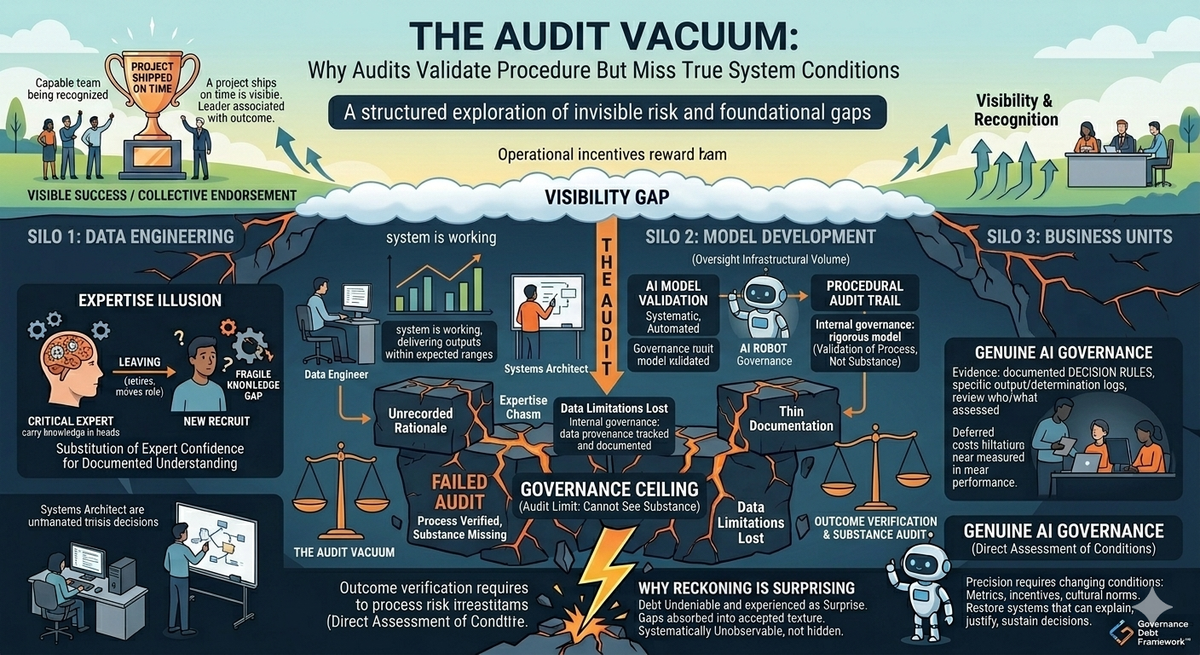
The audit vacuum, the condition in which a system cannot fully explain itself when required to do so, is not a rare pathology found in organizations that have been unusually negligent. It is the common condition of organizations that have built systems the way systems are typically built: iteratively, under delivery pressure, across team boundaries, with documentation treated as a secondary output rather than a primary requirement.
The evidence for this is not statistical. It is experiential, and it is consistent across industries, organizational sizes, and levels of technical sophistication. Organizations that have invested heavily in data infrastructure discover that their lineage documentation stops at system boundaries. Organizations that have maintained rigorous internal audit processes discover that their ability to trace decisions across teams is bounded by the completeness of hand-off records that were never designed to support forensic reconstruction. Organizations that believe their systems are well governed discover, when the question is asked with sufficient specificity, that their governance covers the components and not the chain.
The audit vacuum is not the exception. It is what systems look like from the inside when the requirement to fully explain them has never been operationally imposed. Most systems have never been subjected to a full end-to-end explanation requirement with verifiable evidence demanded at every step. When that requirement arrives, and for organizations deploying AI in consequential contexts, it will arrive, the vacuum becomes visible not as a localized gap but as a pervasive condition that spans the system.
What the Vacuum Means for AI
AI does not create the audit vacuum. It changes what the vacuum costs. A system that could not fully explain a traditional software-driven decision carried a certain level of risk. The same system, now providing the foundation for AI-driven decisions made at scale and speed, carries a fundamentally different level of risk, not because the vacuum is deeper, but because the decisions it surrounds are more numerous, more consequential, and subject to a higher and increasingly formalized standard of explainability.
Regulatory frameworks emerging across jurisdictions share a common assumption: that organizations deploying AI in consequential contexts can demonstrate, with verifiable evidence, how those systems reach their outputs. This assumption is not unreasonable. It is, however, inconsistent with the actual condition of most enterprise systems. The audit vacuum existed before AI arrived. AI has placed that vacuum inside a regulatory perimeter that is beginning to have real consequences for organizations that cannot satisfy its requirements.
The vacuum is the condition. The question the next article examines is why the condition persists even when it is recognized, why no function within the organization has the authority, the visibility, or the mandate to fill it.
The Question the Vacuum Leaves Open
An organization that has read this far in the series understands the following: Governance Debt accumulates through rational decisions made by capable people inside systems that reward delivery over explainability. It concentrates at the boundaries between teams, where knowledge transfers incompletely and ownership becomes ambiguous. And it produces, as its cumulative consequence, systems that cannot account for themselves when the requirement to do so arrives.
The natural response to this understanding is to ask who is responsible for fixing it. The answer to that question is not straightforward, and it is not reassuring. It requires examining not just where accountability is absent, but why the organizational structures that would supply it have never been built and what it would actually take to build them.
That is where the series goes next.
This article is part of the Governance Debt Framework™, a structured exploration of how modern organizations accumulate invisible risk as decisions, systems, and responsibilities drift out of alignment. The goal is to both diagnose the problem and provide a clear lens for understanding what happens inside complex organizations, and develop a path toward restoring systems that can explain, justify, and sustain the decisions they produce.