The AI Sanctions Count Just Passed 1,725. Could Your Firm Answer for Its Share?
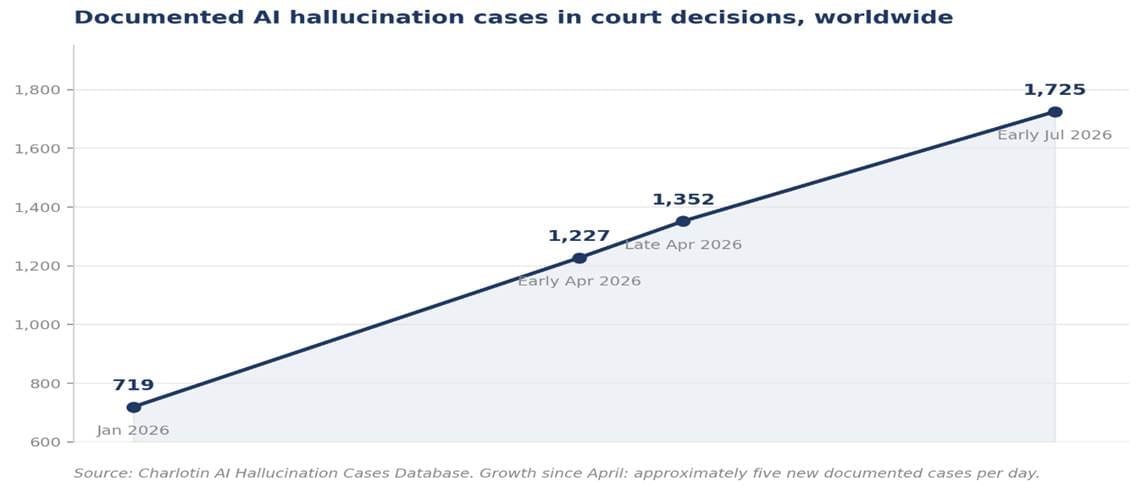
The enforcement record is compounding faster than firm policy adoption. The first full analysis of the Charlotin AI Hallucination Cases Database showed 1,352 cases in late April, and now 1,725 in July. The professional consequence curve is no longer flat.

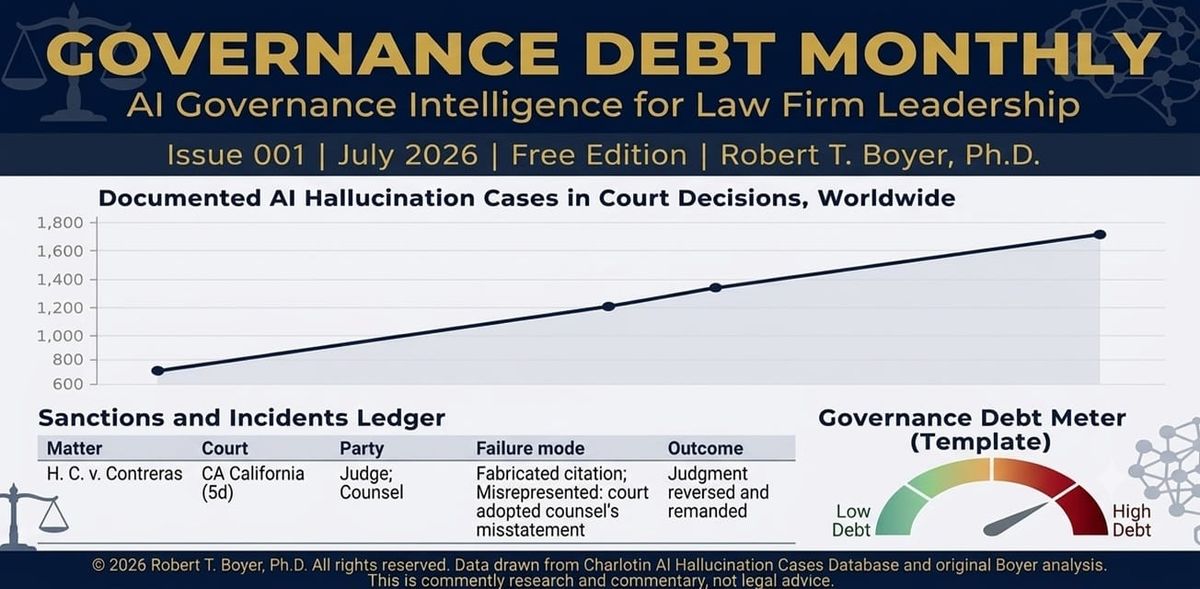
GOVERNANCE DEBT MONTHLY
AI Governance Intelligence for Law Firm Leadership
Issue 001 | July 2026 | Free Edition | Robert T. Boyer, Ph.D.
The AI Sanctions Count Just Passed 1,725. Could Your Firm Answer for Its Share?
1. The Signal
The enforcement record is compounding faster than firm policy adoption. When the first full quantitative analysis of the Charlotin AI Hallucination Cases Database was completed in late April, it held 1,352 documented court findings. As of this writing it holds 1,725. That is roughly 370 new decisions in ten weeks, a run rate of about five new documented cases per day, and the count includes only matters where a court or tribunal addressed the AI use on the record. The unlitigated exposure beneath it is necessarily larger.
Two features of the growth matter more than the total. First, sanctions have moved up the court hierarchy. The case that opened this record, Mata v. Avianca in 2023, drew a 5,000 dollar sanction at the federal district court level. In March, a federal court of appeals sanctioned counsel 15,000 dollars per attorney for fabricated citations in an appellate brief: a higher court, a higher penalty, and a signal that appellate panels are no longer treating hallucinated filings as a trial-court problem. Second, the first bar suspensions tied to AI filings have now entered the record. The professional consequence curve is no longer flat.
What this means for your firm: if your AI policy still frames hallucination as an associate training problem, the enforcement record now frames it as a firm supervision problem under Model Rules 5.1 and 5.3. Courts are sanctioning the signing attorney and, increasingly, the firm. The gap between those two framings is Governance Debt, and this issue quantifies where it is accruing.
The running count
|
Date |
Documented cases |
Note |
|
January 2026 |
719 |
Reported count at the start of the year |
|
Early April 2026 |
1,227 |
Growth of roughly 500 cases in one quarter |
|
Late April 2026 |
1,352 |
Snapshot used for the baseline analysis |
|
Early July 2026 |
1,725 |
Current count; about five new documented
cases per day |
2. Sanctions and Incidents Ledger
Each issue logs a few of the month's new United States entries from the database pull, coded by court, party type, failure mode, and outcome, with the running trend chart updated. The ledger below shows the format with the most consequential recent entry and the trend data.
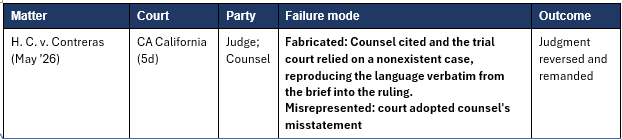
This is one entry. The full Ledger for July 2026 logged 5 entries this month. The 4 not shown here include the quarter's largest single sanction, $80,056 plus a bar referral, and a case where the court revoked pro hac vice status and disqualified resident counsel entirely, the most severe procedural outcome logged this quarter.
All 5 are coded by court, party, and failure mode, cross-referenced against the trend line, and broken down in full only in the paid edition. Subscribe on Ghost
In the Paid Edition This Month
The full issue names what the Signal only points at. Three more sections, each a deliverable you don't currently have:
Regulatory and Bar Watch — a sitting chief justice put AI fake citations on the record this month, and the list of court-specific AI certification requirements keeps growing and keeps disagreeing with itself.
The Governance Debt Meter — this month's scored practice is one nearly every firm is running right now, rated across visibility, accountability, and remediation trajectory. The verdict names it high-interest debt.
The Deep Dive — independent benchmarking of the leading legal AI research platforms, and the failure type it surfaces that most firms' verification protocols are structurally blind to.
Before You Close This
Ask around your own executive committee this month whether anyone could produce, inside a day, a certified list of every AI-assisted filing from the last ninety days. Most firms discover the honest answer is no, not because anyone did anything wrong, but because no one currently owns the question. That gap has a name. Pricing it is what the rest of this issue does.
Read the full Issue 001, including the complete Ledger, this month's scored practice, the benchmark findings, and the Partner Question built to carry into your next executive committee meeting: Subscribe on Ghost
Prefer email? Join the free list for one Ledger preview a month that never runs on LinkedIn: Join the free list
Governance Debt Monthly is research and commentary on AI governance for law firm leadership. It is not legal advice, and no attorney-client relationship is created by subscription or receipt. Data drawn from the Charlotin AI Hallucination Cases Database and original Boyer analysis. © 2026 Robert T. Boyer, Ph.D. All rights reserved.