The Accumulation Problem: How Rational Decisions Build Irrational Risk
The debt is not the residue of failure. It is the residue of success, measured the way most organizations have chosen to measure it.

The Competence Trap
When Governance Debt is discovered, when a system cannot explain itself, when a decision cannot be traced, when an audit exposes gaps that should not exist, the instinct is to find the failure. The underfunded team. The corner that was cut. The leader who deprioritized the wrong thing. This instinct is understandable and almost always misdirected.
Governance Debt does not accumulate because organizations are poorly run or because the people inside them are inattentive. It accumulates because capable people, working inside well-structured organizations, make decisions that are individually rational, collectively endorsed, and systematically rewarded; those decisions, compounded over time, produce systems that function operationally but resist explanation. The debt is not the residue of failure. It is the residue of success, measured the way most organizations have chosen to measure it.
Understanding why requires looking not at the exceptions, the shortcuts taken under pressure, the documentation skipped in crisis, but at the ordinary, daily logic of how organizations decide what matters.
What Organizations Actually Reward
Every organization has a formal set of values and an operational set of incentives. When the two diverge, behavior follows the incentives. In most organizations, those incentives have been structured, intentionally or not, to treat explainability as secondary to delivery.
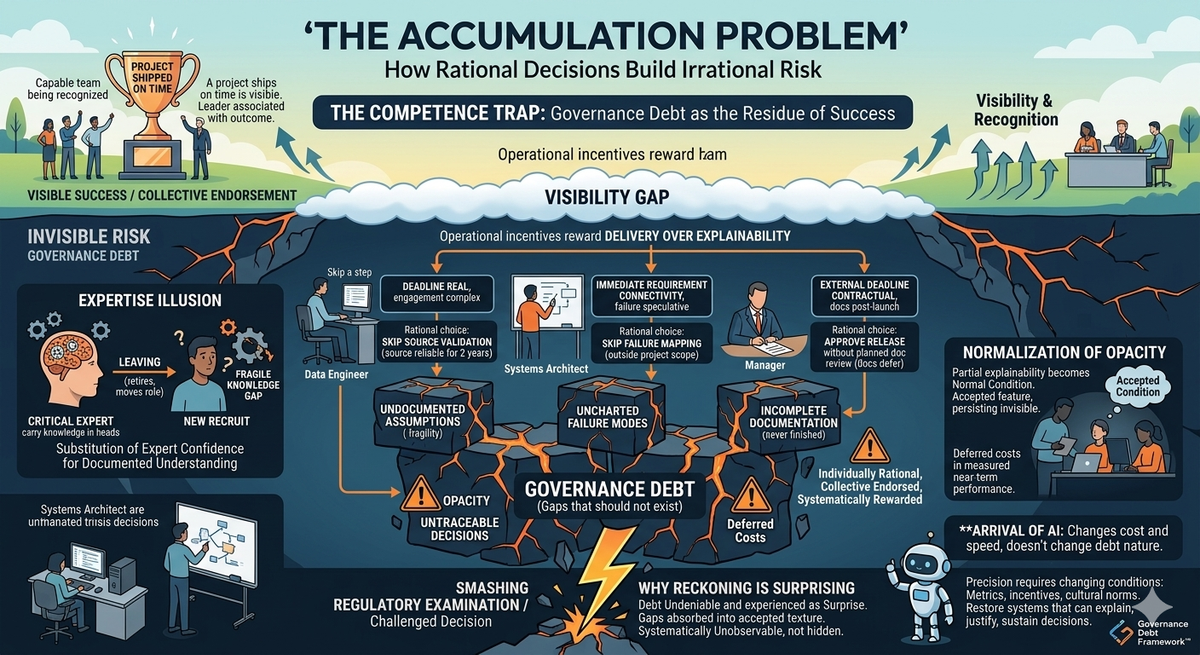
A project that ships on time is visible. The team is recognized. The leader who drove it is associated with outcomes. A project that ships late because the team invested time in documenting data lineage, validating transformation logic, and building audit trails into systems that previously had none is associated with delay. The documentation produced is not visible to the people making performance assessments. The future value of that documentation, the moment years later when a system can actually explain itself under scrutiny, is too distant and too hypothetical to register against the concrete cost of a missed deadline today.
This is not a story about organizations that do not care about governance. Most formally care about it a great deal. It is a story about what happens when caring is expressed through policy statements and oversight checklists rather than through the metrics, incentives, and resource allocations that actually shape behavior. Governance valued in principle but not rewarded in practice will be consistently deprioritized by rational people trying to succeed within the systems they inhabit.
The Rationality of Each Individual Decision
Governance Debt does not typically accumulate through a single significant decision. It accumulates through thousands of small ones, each defensible on its own terms.
A data engineer accepts a source feed without fully validating its provenance because the source has been reliable for two years, the deadline is real, and validation would require engaging two other teams whose cooperation is uncertain and whose timelines are not aligned with the project. The decision is reasonable. The assumption embedded in it, that the source is trustworthy because it has not visibly failed, is undocumented and unverified, but it is also the assumption everyone in the room is making.
A systems architect designs an integration without fully mapping how failures in one component will propagate to others because the immediate requirement is connectivity, the failure scenarios are speculative, and the additional design work falls outside the project scope. The integration works. The failure modes remain uncharted.
A manager approves a release without the planned documentation review because the documentation review is an internal requirement, the external deadline is contractual, and the documentation can be completed after launch. After launch, the next project begins. The documentation is never completed.
None of these decisions is the product of negligence. Each reflects a genuine and reasonable weighing of competing demands. The problem is not the individual decision; it is that the organization has created conditions in which this weighing consistently produces the same outcome: delivery is protected, explainability is deferred. When this pattern repeats across teams, across projects, and across years, the result is a system that works but cannot account for itself.
The Expertise Illusion
There is a cultural dynamic that accelerates accumulation and makes it harder to see: the substitution of expert confidence for documented understanding.
In most organizations, there are people who carry critical system knowledge in their heads. They know why the data pipeline was built the way it was. They know which fields in the legacy system are reliable and which carry known anomalies the team has learned to work around. They know the decision logic behind a transformation that was never formally documented because the person who designed it is still present and available to explain it.
This expertise is real and valuable. It is also a form of Governance Debt invisible because it functions well enough in normal operations. The system appears to be understood. Questions get answered. Audits are navigated. The knowledge exists; it is simply located in people rather than in documentation, which means it is fragile in ways that do not become apparent until those people are unavailable.
When the expert leaves, retires, or moves to another role, the knowledge does not transfer cleanly. What transfers is a partial account, reconstructed from memory and filtered through whatever documentation happens to exist. The gaps left behind are not immediately recognized as gaps, because the system continues to operate. The debt surfaces later, often much later, when the system must be explained to someone who was not present when it was built and cannot rely on institutional memory to fill what the documentation omits.
Organizations that rely on expert knowledge as a substitute for documented understanding are carrying Governance Debt they cannot see and are not positioned to measure.
The Normalization of Opacity
Over time, something more consequential happens. The partial explainability of systems stops feeling like a problem and starts feeling like the normal condition of complex organizations. Teams learn to work within it. Leaders learn to manage around it. The inability to fully trace a decision or fully validate a data source becomes an accepted feature of the operational environment rather than a recognized liability.
This normalization is perhaps the most significant dynamic in the accumulation of Governance Debt, because it removes the internal pressure that might otherwise prompt remediation. A gap recognized as a gap creates discomfort. A gap absorbed into the accepted texture of organizational life creates nothing. It simply persists, invisible to the people who have adapted to its presence, accumulating quietly beneath systems that appear to be functioning well.
The normalization is reinforced by the absence of visible consequences. Governance Debt does not produce consistent operational failures. Systems that cannot explain themselves often continue to deliver correct outputs. Pipelines with undocumented transformation logic continue to produce usable results. Decisions that cannot be traced end-to-end continue to be made and implemented without immediate incident. The debt is real, but its cost is deferred. Deferred costs, in organizations measured on near-term performance, do not generate corrective action.
Why the Moment of Reckoning Is Always Surprising
Given all of this, the moment when Governance Debt becomes undeniable, a regulatory examination, a challenged decision, an audit requiring end-to-end reconstruction, is almost always experienced as a surprise. Not because the debt was deliberately hidden, but because the organizational systems that accumulated it were not designed to make it visible.
Performance metrics did not measure it. Incentive structures did not penalize it. Cultural norms had absorbed it as a feature of complexity rather than naming it as a liability. The expert who could have explained the system is no longer available. The documentation that would have made the audit straightforward was the thing consistently deprioritized when deadlines were real.
The surprise is genuine. The debt was genuinely invisible to the people who carried it, not because they were not paying attention, but because the organization had structured itself in a way that made the debt systematically unobservable until it was no longer avoidable.
This is the condition into which AI is now being introduced. Not into organizations that failed to govern themselves, but into organizations that succeeded on the terms their incentive structures defined, and in doing so built systems that function without being fully understood. The arrival of AI does not change the nature of that debt. It changes what the debt costs and how quickly the bill arrives.
The Human Problem Beneath the Structural One
The remaining articles in this series examine where Governance Debt lives structurally: in the fractures between teams, in the absence of end-to-end accountability, in the timeline of accumulation that most organizations have never mapped. Those structural realities are real and important. But they rest on this more fundamental dynamic: the debt was not built by accident or inattention. It was built by rational people responding rationally to the systems that shaped their decisions.
That is not a reason for resignation. It is a reason for precision. Reducing Governance Debt requires changing the conditions that produce it, the metrics, the incentive structures, the cultural norms that treat explainability as optional when delivery is at stake. Without that change, governance frameworks remain additions to a system that will continue generating debt faster than any framework can address it. The structural problems come next. But the human problem is where the accumulation begins.
This article is part of the Governance Debt Framework™, a structured exploration of how modern organizations accumulate invisible risk as decisions, systems, and responsibilities drift out of alignment. The goal is to both diagnose the problem and provide a clear lens for understanding what happens inside complex organizations, and develop a path toward restoring systems that can explain, justify, and sustain the decisions they produce.