The Accountability Gap: Why No One Owns the Full Chain
The chain exists. The accountability for the chain does not.

The Question That Stops the Room
There is a question that, when asked with sufficient precision in the right organizational setting, produces a specific and revealing silence. It is not a hostile question. It is not a trick. It is simply this: who in this organization is accountable for the integrity of the full chain, from the origin of the data, through every transformation and system boundary, to the decision or output that chain ultimately produces?
The silence that follows is not the silence of people who do not understand the question. It is the silence of people who understand it perfectly and recognize, in the moment of being asked, that the answer is no one. Not in any formal, enforceable, organizationally supported sense. There are people accountable for components. There are functions responsible for domains. There are oversight structures that monitor defined perimeters. But the chain itself, the end-to-end sequence that connects data provenance to consequential output, belongs to no one, and the structures that would make it possible for anyone to own it have never been built.
This is not a gap that exists because organizations failed to notice it. It is a gap that exists because closing it requires something that organizational design has consistently and predictably resisted: the assignment of authority that crosses the boundaries of existing power structures.
How Accountability Is Actually Assigned
To understand why no one owns the full chain, it is necessary to be precise about how accountability is assigned in complex organizations, because the mechanism is not arbitrary. It follows a logic that is internally coherent and organizationally rational, even as it produces the gap this article examines.
Accountability in most enterprises is assigned to bounded domains. A function is given responsibility for a system, a process, a dataset, or a defined set of outcomes within a defined perimeter. The boundaries of that perimeter are set by organizational structure, reporting lines, budget authorities, and the scope of the function's mandate as understood by the people who created it. Within those boundaries, the function can set standards, enforce controls, demand documentation, and impose consequences for non-compliance. Outside those boundaries, it cannot.
This design is not irrational. It reflects the genuine difficulty of assigning accountability for outcomes that depend on the actions of people and systems outside any single function's control. Accountability without authority is not accountability, it is exposure. Organizations understand this, and they structure accountability accordingly: you are responsible for what you control, and your control is bounded by your organizational perimeter.
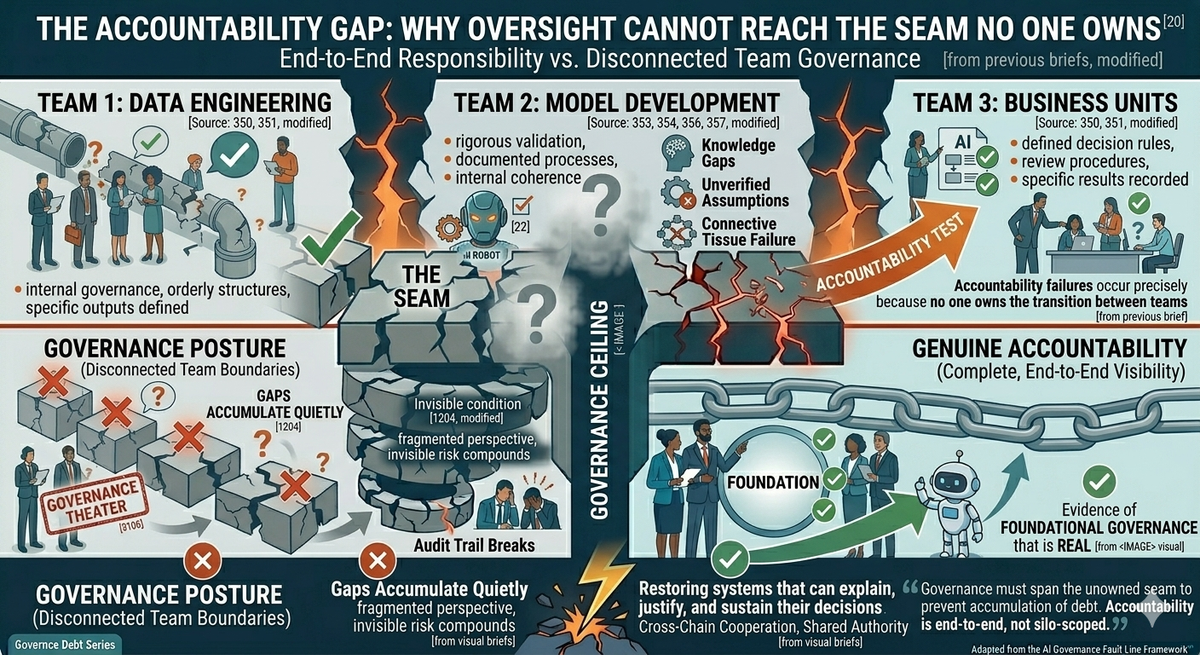
The consequence of this design, applied consistently across a complex enterprise, is a system of interlocking domain accountabilities with no mechanism for chain accountability. Each domain is owned. The connections between domains are not. Each function is responsible for its outputs. No function is responsible for what those outputs become when combined with the outputs of other functions across the chain. The full chain exists operationally but not organizationally. It produces real outcomes but has no owner.
The Distributed Governance Illusion
Most organizations, if asked directly, will assert that governance of their systems is comprehensive. They can point to a data governance function, a risk management function, a compliance function, an internal audit function, and, increasingly, an AI governance function. Each of these exists. Each has a defined mandate. Each produces reports, maintains frameworks, and demonstrates activity. The organization is, by any reasonable measure, heavily governed.
And yet the audit vacuum exists. The hand-off fractures persist. The full chain cannot be explained. How is this possible in an organization with so many governance functions?
The answer is that governance coverage and governance coherence are not the same thing. An organization can have complete coverage, every domain governed by some function, while having no coherence across domains. The data governance function governs data within its defined scope. The risk function governs risk within its defined perimeter. The compliance function ensures adherence to requirements within its assigned domain. None of these functions is scoped to the interactions between domains, to the integrity of the chain that connects them, or to the cumulative governance condition of the full system.
The result is what might be called the distributed governance illusion: the appearance of comprehensive governance produced by the aggregation of domain-level governance functions that do not, individually or collectively, produce visibility or accountability across the full chain. The organization believes it is governed because it has governance functions. What it has is governed components connected by ungoverned seams, a condition that looks like full governance from inside any single domain and reveals itself as partial governance only when the full chain is examined end to end.
Why the Gap Persists When It Is Recognized
The accountability gap would be straightforward to address if recognition of it were sufficient to close it. It is not, and the reason is structural rather than motivational. Organizations that identify the gap, and many have, particularly as AI has made it more visible, consistently find that closing it requires actions that existing organizational structures are designed, in effect, to prevent.
Closing the accountability gap requires assigning someone meaningful authority over a chain that crosses multiple existing domains. That authority must be real: the ability to set standards that teams are required to meet, to access systems and documentation across organizational boundaries, to impose consequences when the integrity of the chain is compromised by actions within any domain. Without that authority, chain-level accountability is nominal. It exists as a title or a mandate on paper, but it cannot be enforced where enforcement requires crossing into another function's domain.
Assigning that authority requires someone to give it up. The functions that currently own their respective domains must accept that a cross-chain governance function has legitimate authority over aspects of their operation. This is an authority conflict, and authority conflicts in complex organizations are resolved slowly and incompletely, if at all. The data engineering leader whose team's practices are now subject to oversight by a chain-level governance function did not agree to that arrangement when the function was created. The business unit whose decision processes are now subject to end-to-end traceability requirements did not build its operating model around that constraint. Each function has legitimate interests in maintaining its operational autonomy, and those interests are backed by organizational relationships, budget authorities, and political capital that a newly created cross-chain governance function typically does not have.
The result is that cross-chain governance initiatives, when they are launched, tend to produce influence rather than authority. They produce recommendations rather than requirements. They produce frameworks that domain functions are encouraged to adopt rather than mandated to implement. They produce the form of chain-level governance without the substance, because the substance requires authority that the organizational structure has not granted and that existing power structures will not readily yield.
The Budget Boundary Problem
There is a dimension of the accountability gap that is less frequently examined but equally structural: the budget boundary. In most organizations, budget authority follows organizational structure. Functions control their own budgets, and the allocation of resources within a domain is the domain leader's decision. Cross-domain initiatives must be funded through mechanisms that require cooperation across budget authorities, shared funding arrangements, centrally allocated resources, or negotiated contributions from multiple functions.
This creates a direct constraint on the ability to address chain-level governance gaps. Remediating the audit vacuum, building the lineage documentation, preserving the intermediate states, establishing the controls that would make end-to-end explanation possible, requires investment in systems and processes that span multiple domains. That investment cannot be authorized by any single domain leader, because the work falls outside any single domain's budget authority. It requires a cross-domain funding decision, which requires cross-domain agreement, which requires the kind of organizational alignment that the distributed governance structure was not designed to produce.
The practical consequence is that chain-level governance remediation is consistently underfunded. Not because organizations do not recognize its value, but because the mechanism for funding it does not fit neatly within the budget structures that exist. It falls between functions, just as accountability does. It belongs to no one's budget for the same reason it belongs to no one's mandate: the organizational architecture was not designed with the chain in mind.
The Authority Vacuum at the AI Layer
The accountability gap predates AI by decades. What AI has done is place that gap inside a context where its consequences are no longer manageable through the informal mechanisms that previously contained them.
When consequential decisions were made at human pace, the accountability gap could be navigated through relationships, institutional memory, and the accumulated judgment of people who understood the system even when they could not document it. When a question arose, the right person could usually be found and the approximate account could usually be constructed. The gap was real but the cost of carrying it was low enough to be tolerable.
AI removes those navigational mechanisms. It makes decisions at a scale and speed that cannot be managed through relationships and memory. It generates outputs that must be explainable to regulators and auditors who were not present when the system was built and who will not accept approximate accounts constructed after the fact. It operates within a regulatory environment that is beginning to impose specific and enforceable explainability requirements on the organizations that deploy it.
The authority vacuum that was a manageable organizational inconvenience has become an AI governance liability. The organization needs someone to own the full chain. No one does. The structures that would make ownership possible do not exist. And the processes by which those structures would be built, the resolution of authority conflicts, the crossing of budget boundaries, the acceptance of cross-domain accountability, are precisely the processes that existing organizational design resists most effectively.
The Structural Verdict
The articles in this phase of the series have moved through three levels of the same problem. Governance Debt accumulates through rational individual decisions made inside systems that reward delivery over explainability. It concentrates at the boundaries between teams, where knowledge transfers incompletely and ownership becomes ambiguous. It produces systems that cannot explain themselves when required to do so. And it persists, not despite organizational awareness, but alongside it, because the structures required to address it conflict with the organizational architecture that produced it.
This is the structural verdict: Governance Debt is not merely an accumulation problem or a documentation problem or a technology problem. It is an organizational design problem. The chain exists. The accountability for the chain does not. And the gap between them is not a temporary condition awaiting a motivated leader or a better framework. It is a stable feature of how complex organizations assign authority, allocate budgets, and define the boundaries of accountability.
Awareness of this condition is necessary. It is not sufficient. The reader who has followed this series to this point understands the full architecture of the problem: where it comes from, where it lives, what it produces, and why it persists. What remains is the question the series has been building toward, what AI specifically does to this condition, why it makes the cost of persistence unavoidable, and what genuine remediation requires.
That is where the series goes next.
This article is part of the Governance Debt Framework™, a structured exploration of how modern organizations accumulate invisible risk as decisions, systems, and responsibilities drift out of alignment. The goal is to both diagnose the problem and provide a clear lens for understanding what happens inside complex organizations, and develop a path toward restoring systems that can explain, justify, and sustain the decisions they produce.