Governance Debt Was Never a Series to Finish
That is what proof looks like when a framework is sound: it shows up somewhere the series didn't plan for, described in language the series didn't use, and fits anyway.

Why the Framework Continues as Governance Debt Monthly
Two Endings, One Series
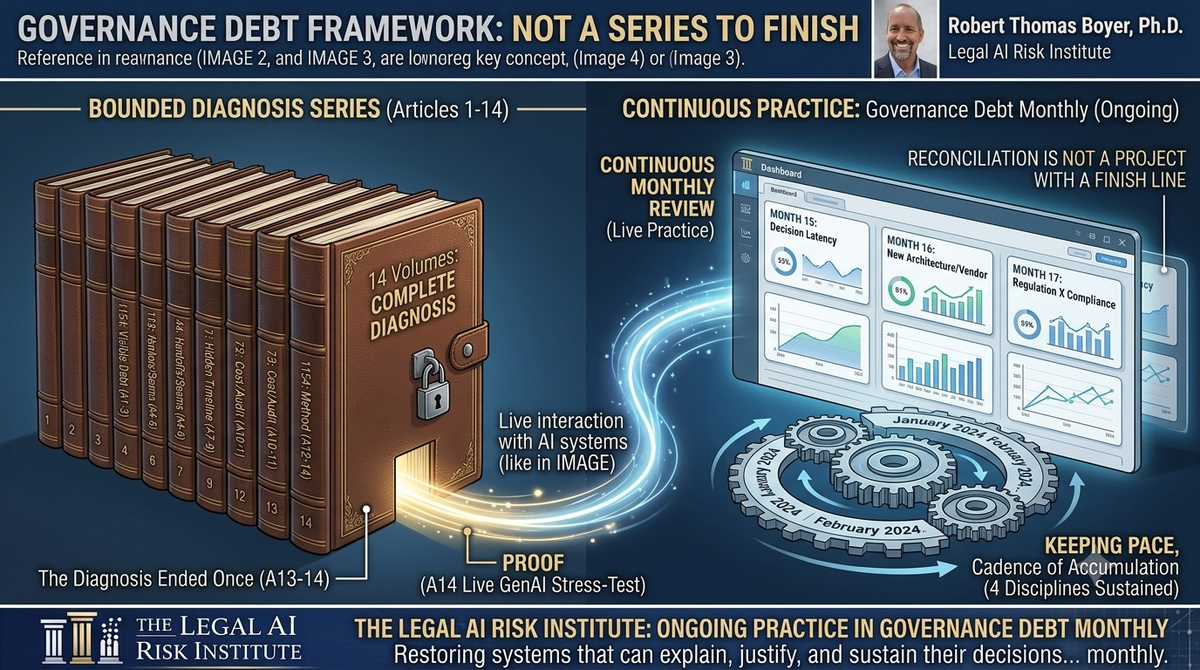
This series has already ended once.
Article Thirteen closed it properly: five phases delivered exactly as promised, from the individual instinct that lets capable people trust systems they've never examined, through the structural seams where debt concentrates, through the moment AI made that debt unaffordable, to the method for reconciling it and an honest account of what stays permanently outside anyone's control. It ended the way a diagnosis should end — not with a promise of more symptoms, but with an account of what health actually requires: control as a discipline, sustained, not a certificate awarded once.
Then Article Fourteen arrived, and the series kept going.
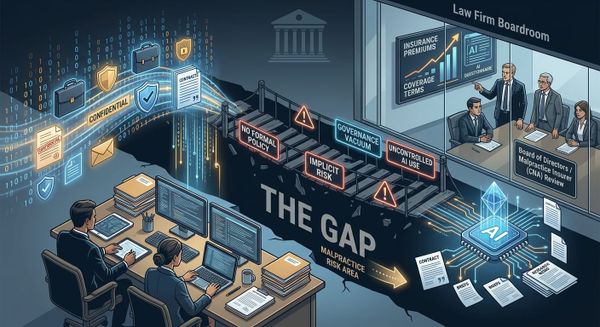
That was not a mistake. It was evidence. A law firm running GenAI into its own billing model, its own intake ambiguity, its own decision latency, is Governance Debt behaving exactly as Article Thirteen said it would: not resolved by reconciliation, but continuously tested by whatever pressure arrives next. Article Fourteen did not extend the diagnosis. It confirmed it, in the wild, faster than the series could have planned for.
Which leaves an honest structural problem. A fourteen-part series with two endings, one philosophical, one applied, is not actually finished. It proved its own thesis, and in doing so made clear that the format built to prove it, a bounded series with a last installment, was never going to be adequate to what it was describing.
What the Five Phases Actually Established
It's worth being precise about what those fourteen articles built, because this one has to stand on all of it, not summarize it away.
Phase one made the debt visible in human terms: the trust capable people extend to systems that perform, mistaken for evidence the systems are sound (Article One); the compliance architecture that produces false assurance instead of real oversight (Article Two); the accumulation of that gap through individually rational decisions that reward delivery over explainability (Article Three).
Phase two located where the debt concentrates structurally: the hand-offs no governance framework crosses (Article Four); the systems that cannot reconstruct their own decisions under scrutiny (Article Five); the authority vacuum that leaves no one positioned to close what accumulates at the seams (Article Six).
Phase three traced what happens when AI arrives into that condition: the hidden timeline along which the debt compounds invisibly until it doesn't (Article Seven); the moment AI governance fails before it begins, because the foundation it depends on was never built (Article Eight); the three properties, traceability, transformation transparency, visible system interactions, that no framework can create and every framework assumes (Article Nine).
Phase four turned the series to face the reader directly: the six-stage audit that locates exactly where your own chain breaks (Article Ten); the three-dimensional cost, regulatory, operational, and foregone value, that Governance Debt extracts whether or not it's ever named (Article Eleven).
Phase five delivered the method: assessment, sequencing, and organizational requirements as the three elements reconciliation actually requires, in that order (Article Twelve); and the four disciplines, documentation, monitoring, governance rhythm, and explainability culture, that sustain what reconciliation establishes against the organizational pressure that will otherwise erode it (Article Thirteen).
That is a complete structure. Nothing in it is missing. Article Fourteen didn't complete it. It stress-tested it, on a live system, under real economic pressure, and the framework held.
The Proof Arrived Before the Conclusion Did
Amdahl's Law is not a governance concept. It's a constraint on parallel systems, borrowed from computing, and Article Fourteen used it to explain something the series had already diagnosed in different language: accelerating the fast, visible parts of a system, drafting, research, output, does nothing to the slow, sequential parts, decision authority, intake, workflow, economics, that actually set the ceiling. That is the accountability gap and the hidden timeline, restated as an equation. The law firm in Article Fourteen wasn't a new case. It was Articles Six and Seven, given a number.
That is what proof looks like when a framework is sound: it shows up somewhere the series didn't plan for, described in language the series didn't use, and fits anyway.
Practice Requires a Cadence
Article Thirteen argued that control over AI systems is not a destination, it's a practice: four disciplines, sustained continuously, against pressure that never stops generating new debt. That argument has a consequence the series didn't name out loud until now. A practice sustained continuously cannot be documented by a series with a last installment. The format contradicts the claim.
A fourteen-article series that ends is a diagnosis. A practice that continues needs a record that continues with it, one that can name new pressures as they arrive, a new regulation, a new vendor default, a new architecture that outpaces the frameworks built for the last one, with the same specificity the first fourteen articles brought to the pressures that already existed.
Governance Debt Monthly
That record is Governance Debt Monthly.
It is not a rebrand and it is not a restart. It is the fourteen articles' own conclusion, taken seriously: reconciliation is not a project with a finish line, so the record of it cannot be either. Each month examines where the foundation is shifting, what the six-stage test finds when it's run against decisions made that month rather than decisions made a year ago, and what new constraint has surfaced now that the last one has been addressed, because under Governance Debt, there is always a next one.
If the fourteen articles before this one named a condition your organization recognized, the work now is not closing a file on it. It's keeping pace with it, on the same cadence the debt itself accumulates, so that the systems your organization runs stay ones that can explain, justify, and sustain the decisions they produce, monthly rather than once. The Legal AI Risk Institute works with law firms, insurers, and governance leaders on exactly that ongoing practice. Governance Debt Monthly is where it becomes visible in public, one month at a time.
This article is Article 15 of the Governance Debt Framework™, and the last in its original, numbered form. The practice it describes continues in Governance Debt Monthly.
This article is part of the Governance Debt Framework™, a structured exploration of how modern organizations accumulate invisible risk as decisions, systems, and responsibilities drift out of alignment. The goal is to both diagnose the problem and provide a clear lens for understanding what happens inside complex organizations, and develop a path toward restoring systems that can explain, justify, and sustain the decisions they produce.