Governance Debt Reconciliation: The Missing Prerequisite to AI Governance
Where the chain breaks, the sophistication of the governance framework layered on top is not a defense. It is evidence that the organization understood the obligation and could not meet it.

The Difference Between Urgency and Direction
The preceding articles in this series were designed to produce a specific organizational state: the clear, uncomfortable, and fully grounded recognition that Governance Debt is real in your organization, that it is costing you in ways that have not been appearing in your reporting, and that the AI governance frameworks you have built or are building cannot function at the depth their design implies because the foundational conditions they depend on have not been established.
That recognition is necessary. It is not sufficient. Urgency without direction produces one of two outcomes: paralysis, in which the scale of the problem prevents the organization from beginning because no starting point feels adequate to the whole; or misdirection, in which the organization begins with what is most visible rather than what is most consequential, producing activity that creates the appearance of progress without addressing the condition that generates the cost.
This article provides the direction. Not as a generic framework that applies equally to every organization regardless of its specific foundational condition, its AI portfolio, its regulatory environment, or its organizational structure. As a structured method, specific enough to apply, honest enough about the difficulty of application, and grounded in the full architecture of the problem that the preceding articles have established.
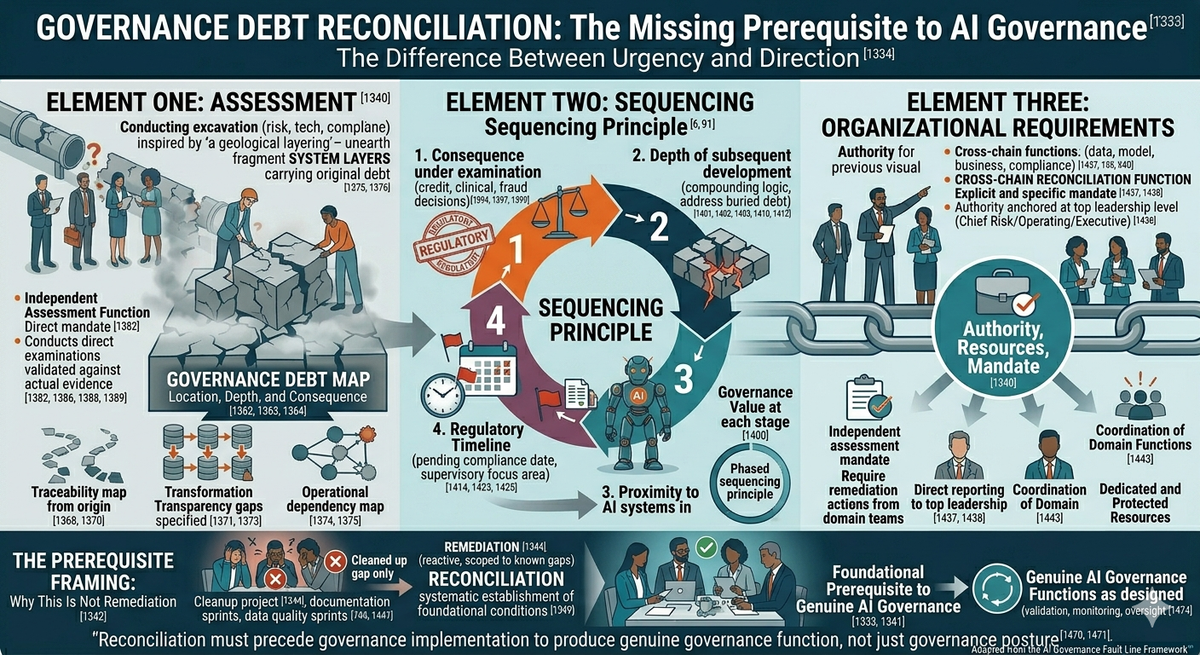
The method has three elements: assessment, sequencing, and organizational requirements. Each builds on the others. None is sufficient alone. Together, they constitute what the series title has been pointing toward from the beginning: Governance Debt reconciliation, the missing prerequisite to AI governance that actually works.
The Prerequisite Framing: Why This Is Not Remediation
Before the method, the framing. It is the most important intellectual move this article makes, and it must be held precisely because the organizational tendency will be to drift away from it toward something more familiar and less demanding.
Governance Debt reconciliation is not remediation. It is not a cleanup project appended to an existing AI governance program. It is not a documentation initiative, a data quality sprint, a lineage mapping exercise, or a governance framework enhancement. These activities may be components of reconciliation. They are not reconciliation itself, and treating them as such is the most common and most costly mistake organizations make when they attempt to address the foundational condition this series has described.
Remediation addresses specific, identified failures after they have been recognized as problems. It is reactive by nature, scoped to the gap that was found, and complete when that gap is closed. Reconciliation is different in kind. It is the systematic establishment of foundational conditions that governance requires, across the full portfolio of systems that AI depends on, regardless of whether specific gaps have yet been identified as problems, and with the explicit recognition that the conditions being established are prerequisites for governance rather than enhancements to it.
The distinction matters because it determines how the work is scoped, resourced, sequenced, and governed. Remediation is scoped to known gaps. Reconciliation is scoped to the full chain. Remediation is resourced as a project with a defined end state. Reconciliation is resourced as an ongoing discipline with milestones rather than a completion date. Remediation is governed as an operational workstream. Reconciliation requires the kind of cross-chain authority that the series has established does not currently exist in most organizations and must be deliberately created.
When organizations frame Governance Debt reconciliation as remediation, they consistently underscope it, under-resource it, and under-govern it, producing documentation of recent gaps while leaving the buried, compounded debt that carries the greatest regulatory and operational risk untouched. When they frame it as a prerequisite, as the foundational investment that must precede effective AI governance rather than supplement it, they are positioned to direct effort where consequence is greatest and to build organizational capacity that persists beyond any individual workstream.
That is the framing. Hold it. The organizational pressure to reframe reconciliation as a bounded cleanup project will be significant, because the prerequisite framing makes demands that the remediation framing does not. Those demands are real. They are also the conditions that make reconciliation actually work.
Element One: Assessment
The audit test in article ten asked you to examine one decision through one chain and locate the point at which your explanation broke. That was a probe, a single-decision instrument designed to make the governance ceiling visible and personal. Assessment is different in scope and purpose. It is the systematic examination of foundational conditions across the full portfolio of systems that your AI depends on, designed to produce a complete and accurate picture of where Governance Debt exists, how deep it runs, what has been built on top of it, and what the consequence of each gap represents given the AI systems currently operating on it.
The output of assessment is not a list of documentation gaps. It is a map, a structured representation of the foundational condition of your AI-dependent systems that shows the location, depth, and consequence of Governance Debt across the full chain. That map is the instrument that makes sequencing possible, that makes the business case for reconciliation investment specific rather than general, and that makes the organizational case for the authority reconciliation requires concrete rather than theoretical.
Assessment examines each of the three foundational properties that article nine defined, across each system in the portfolio, with enough specificity to support sequencing decisions.
For traceability, assessment asks: for each AI system in production, can the full chain of data provenance be documented with contemporaneous evidence from origin through model input? Where does documented evidence give way to inference, institutional memory, or general process description? What is the oldest undocumented element in the chain, and what has been built on top of it since? The answers to these questions produce a traceability map that shows not just where the gaps are but how deeply they are buried and how much subsequent development depends on them.
For transformation transparency, assessment asks: for each transformation applied to data in the chain, does contemporaneous documentation exist specifying what the transformation does, why it was designed that way, when it was last validated, and whether it has been modified since its original implementation? Where transformation logic exists only in code without specification, or in the memory of people who may no longer be present, or in general descriptions that do not capture the specific decisions made in implementation, those locations are transformation transparency gaps, and their consequence is determined by how sensitive the AI systems downstream of them are to the characteristics of the data they transform.
For visible system interactions, assessment asks: does a current, accurate map of system dependencies exist that covers every component in the chain from data origin to AI output, including the ownership boundaries each dependency crosses and the assumptions each component makes about the reliability of what it receives? Where the dependency map is architectural rather than operational, describing the system as designed rather than as it currently operates, or where it stops at organizational boundaries rather than following the full chain, those locations represent visible system interactions gaps whose consequence is determined by how much AI system behavior depends on the interactions they fail to document.
Assessment must also characterize the depth of each gap, not just its existence but how much subsequent development has been built on top of it. A traceability gap in a data source that was incorporated last quarter and feeds one AI system in a non-critical use case has a different consequence profile than a traceability gap in a data source that has been in operation for eight years and feeds the foundation of six AI systems in regulated domains. The depth characterization is what makes the business case for addressing buried debt rather than only recent gaps, and it is the element most consistently missing from assessments that default to cataloguing what is visible rather than excavating what is buried.
The organizational dimension of assessment is as important as its technical dimension, and it is the element most frequently underestimated in planning. Assessment must be conducted by a function with the authority and mandate to surface findings that existing teams may have incentives to minimize. Teams whose systems will be assessed have legitimate interests in maintaining the perception that their systems are well governed. They have built those systems, they are accountable for them, and a finding of significant Governance Debt in their domain reflects on work they have done and standards they have maintained. The assessment function must have the organizational standing to surface accurate findings regardless of their implications for existing team reputations, and it must have access to systems and documentation that domain teams control.
This means assessment cannot be self-reported. An assessment in which each team evaluates the foundational condition of its own systems and reports findings upward will produce findings calibrated to what teams are comfortable disclosing rather than to the actual condition of their systems. The assessment function must be able to examine systems independently, request documentation directly, and produce findings that are validated against actual evidence rather than team representations of it.
Where that assessment function does not currently exist, and in most organizations it does not, for the reasons article six established, it must be created as the first organizational act of reconciliation. Its creation is not a bureaucratic formality. It is the foundational organizational requirement that makes accurate assessment possible, and accurate assessment is the foundational requirement that makes everything else possible.
Element Two: Sequencing
The map that assessment produces will almost certainly reveal more Governance Debt than any single reconciliation effort can address simultaneously. This is not a reason for resignation. It is the condition that makes sequencing the most consequential decision in reconciliation planning. Sequencing determines which gaps are addressed first, which are addressed progressively, and which are managed through compensating controls while deeper reconciliation proceeds. Done well, sequencing produces governance value at each stage of reconciliation rather than requiring the full effort to be complete before any value is realized. Done poorly, it produces resource exhaustion, incomplete results across all workstreams, and the specific failure mode in which the most visible gaps are addressed while the most consequential ones remain.
Four principles govern sequencing decisions. They should be applied in combination, not in isolation, and their relative weight should be determined by the specific organizational context, the regulatory environment, the AI use cases in production, the organizational capacity available, and the timeline the organization faces.
Consequence under examination is the first and most important principle. The gaps that should be addressed first are not the gaps that are easiest to close or most recently created. They are the gaps whose discovery under regulatory examination, legal challenge, or internal audit would produce the highest cost to the organization. For most organizations operating AI in regulated domains, this means gaps in the chains that support the highest-stakes decisions, credit adjudication, clinical support, hiring determination, fraud detection, regulatory compliance, because these are the chains that regulators will examine first and most rigorously, and whose foundational gaps will produce the most significant findings.
Consequence under examination is not the same as probability of examination. A gap with a low probability of near-term examination but catastrophic consequence if found should be sequenced ahead of a gap with a high probability of examination but manageable consequence. The sequencing decision is a product of both dimensions, and the assessment map should characterize each gap on both.
Depth of subsequent development is the second principle. Gaps that have the most subsequent development built on top of them should be sequenced earlier than gaps of similar consequence where the chain is shorter. This is the compounding logic from article seven applied to sequencing: a gap buried under eight years of subsequent development will cost more to address with every year that passes, because every new system built on top of it extends the reconciliation required to close it. Addressing it earlier is not only less expensive, it prevents the continued accumulation of debt on top of an unresolved foundation.
This principle is the one most directly in tension with organizational comfort, because the gaps with the most subsequent development built on top of them are typically the gaps in the most foundational and most familiar systems, the systems that have been operating longest, that the most people depend on, and that the organization is least comfortable characterizing as carrying significant Governance Debt. The assessment function's independence is what makes it possible to surface these gaps accurately. The sequencing principles are what make it possible to justify addressing them first.
Proximity to AI systems in production is the third principle. Gaps in the chains that directly support AI systems currently making consequential decisions should be sequenced ahead of gaps in systems whose AI use cases are in development, planned, or proposed. The regulatory and operational risk of carrying Governance Debt is a function of the AI systems operating on the foundation it exists in. A gap in a chain that supports an AI system currently processing thousands of decisions per day carries immediate regulatory and operational exposure. A gap in a chain that will support an AI system planned for deployment in eighteen months carries future exposure that can be addressed before deployment rather than after.
This principle interacts with the reconciliation-versus-governance-implementation sequencing question addressed below. AI systems that are planned for deployment on chains carrying significant Governance Debt should not be deployed on the assumption that reconciliation will follow. Deployment creates the exposure. Reconciliation after deployment addresses it under the most difficult conditions.
Regulatory timeline is the fourth principle. Gaps that are most likely to be examined within a defined regulatory timeline, the next examination cycle, a pending rule's compliance date, a supervisory focus area that has been publicly signaled, should be sequenced ahead of gaps of similar consequence whose regulatory timeline is more distant. This is not the same as addressing only what regulators are likely to find. It is the recognition that the cost difference between proactive remediation and reactive remediation under regulatory mandate, established in article eleven, is greatest when the regulatory timeline is shortest.
Sequencing is not a one-time decision made at the beginning of reconciliation and then executed linearly. It is a dynamic process that should be revisited as the assessment map is refined through the reconciliation process itself, as the regulatory environment evolves, and as the AI portfolio develops. The sequencing principles provide the framework for those revisitations. They ensure that each adjustment to sequencing is principled rather than reactive to organizational pressure to address what is most convenient rather than what is most consequential.
Element Three: Organizational Requirements
Assessment produces the map. Sequencing directs the work. Neither produces foundational change without the organizational structures that give reconciliation the authority, the resources, and the mandate it requires. This is the element most consistently underestimated in reconciliation planning and most responsible for reconciliation efforts that produce documentation without foundational change.
The series has established that Governance Debt persists partly because no function has the authority or mandate to govern the full chain. Reconciliation requires that authority to exist, not permanently in the form of a new standing function, though that may ultimately be the right organizational design, but at minimum for the duration and scope of the reconciliation effort, with enough authority to direct work across domain boundaries, access systems that domain teams control, and produce findings and requirements that domain teams are obligated to act on.
That authority must be anchored at a level of the organization with the standing to enforce it. A reconciliation function anchored in a data governance team that reports to a technology leader will not have the organizational standing to impose requirements on a model risk function that reports to the chief risk officer, or to direct remediation work in a business unit whose leader does not report through the same chain. The authority required for cross-chain reconciliation must be anchored at a level above the functions whose cooperation it requires, typically at the chief risk officer, the chief operating officer, or the chief executive level, depending on the organization's structure and the scope of the AI portfolio being reconciled.
The mandate of the reconciliation function must be explicit and specific. It must include the authority to conduct independent assessment of systems in any domain relevant to the AI chains being reconciled, to produce findings that characterize foundational conditions accurately regardless of their implications for existing team reputations, to set remediation requirements that domain teams are obligated to meet on defined timelines, and to report progress and findings directly to the organizational level at which its authority is anchored. Without each of these authorities, the reconciliation function will produce recommendations rather than requirements, and recommendations, as the series has established in the context of governance authority generally, are not the instrument through which foundational change is achieved.
The relationship between the reconciliation function and existing governance functions, data governance, model risk, AI governance, compliance, internal audit, must be designed deliberately rather than left to emerge through practice. These functions are not competitors to the reconciliation effort. They are resources whose domain expertise, existing relationships, and established processes are essential to reconciliation's success. But they are domain-scoped functions, and reconciliation requires cross-domain authority that they do not individually possess. The design that works is one in which the reconciliation function holds cross-chain authority and coordinates domain functions as contributors to reconciliation workstreams within their respective domains, rather than delegating reconciliation responsibility to domain functions and expecting cross-chain coherence to emerge from their coordination.
Resources must be explicit, dedicated, and protected from the operational pressures that will compete for them throughout the reconciliation effort. The single most common failure mode in reconciliation is the gradual reallocation of reconciliation resources to operational priorities as the initial urgency that launched the effort diminishes and the day-to-day demands of running AI systems in production reassert their claim on organizational attention. Protecting reconciliation resources from this reallocation requires that they be explicitly budgeted as a first-order investment, that their allocation be governed at the level at which the reconciliation function is anchored, and that the metrics used to evaluate reconciliation progress be reviewed at that level on a cadence that maintains organizational attention on the effort between the crisis moments that initially generated it.
The Sequencing of Reconciliation and Governance Implementation
Readers who have absorbed this series will arrive at article twelve with a specific question that the method cannot leave unanswered: given that we have AI governance frameworks already in place or in implementation, and given that reconciliation is now established as a prerequisite rather than a supplement, how do these two tracks relate? Do we pause governance implementation while we reconcile? Do we run them in parallel? Do we complete reconciliation before we extend governance further?
The answer is a framework rather than a prescription, because the right answer varies by organizational situation across four dimensions.
The current governance ceiling determines the immediate priority. If the audit test revealed that your governance ceiling is close to the model layer, that traceability breaks within the AI system itself rather than in the upstream systems it depends on, then governance framework enhancement may be the more urgent near-term investment. If the ceiling is in the upstream foundations, in data pipelines, legacy systems, or transformation layers that precede the model, then reconciliation of those foundations is the prerequisite that governance enhancement cannot substitute for.
The AI use cases in production determine the risk profile of the current state. AI systems making consequential decisions at scale in regulated domains on inadequate foundations are generating regulatory and operational exposure continuously. For those systems, reconciliation of the specific chains they depend on should be treated as the most urgent workstream, running ahead of governance framework enhancement in those same chains. AI systems in development or early deployment provide the opportunity to establish foundational conditions before deployment rather than after, and for those systems, completing reconciliation before deployment is the correct sequence.
The regulatory timeline determines the urgency of specific workstreams within reconciliation. If a regulatory examination is scheduled or anticipated within a defined period, the chains most likely to be examined should be the priority reconciliation workstreams regardless of where they fall in the general sequencing priorities. Regulatory timelines do not wait for optimal sequencing.
Organizational capacity determines what is simultaneously achievable. Reconciliation and governance implementation running as fully parallel workstreams require organizational capacity that most enterprises do not have available without explicit resource allocation decisions. Where capacity is constrained, the principled choice is to sequence reconciliation of the highest-consequence chains ahead of governance framework enhancement in those same chains, while allowing governance enhancement to proceed in chains where foundational conditions are adequate or where the AI use cases are less consequential.
The principle that governs this framework, and that should govern every sequencing decision within it, is the one the series has established from the beginning: governance frameworks cannot substitute for foundational conditions. Extending governance frameworks into chains where foundational conditions are inadequate produces governance posture rather than governance function. The effort invested in that extension produces confidence without capability. Investing in foundational conditions first, and extending governance frameworks onto adequate foundations, produces governance that is real rather than present.
What Reconciliation Produces
Governance Debt reconciliation, conducted with accurate assessment, principled sequencing, and adequate organizational authority, produces something that AI governance frameworks alone cannot: foundational conditions that make governance possible at the depth the framework requires.
It does not produce perfect systems. It does not eliminate the complexity that is an inherent feature of enterprise AI environments. It does not guarantee that Governance Debt will not accumulate again, because the incentive structures and cultural dynamics that article three established as its primary causes do not disappear when reconciliation is complete.
What it produces is the transformation of complexity from something that resists explanation into something that can be understood, governed, and extended with confidence. Systems whose data provenance is traced and documented. Transformations whose logic is specified and validated. System interactions that are mapped and monitored. Chains whose accountability can be assigned because the chain is visible from end to end. These are the conditions under which AI governance frameworks function as designed, under which model validation produces findings that reflect the full system rather than the model in isolation, under which monitoring can observe the signals that matter, under which oversight can enforce standards that are meaningful because the processes they apply to are transparent.
They are also the conditions under which AI can be deployed in the highest-stakes contexts where its value is greatest, because those contexts demand the kind of foundational clarity that only reconciliation can establish. The opportunity cost of Governance Debt that article eleven named is the mirror image of the value that reconciliation unlocks: the AI use cases that become possible when the foundational conditions required to govern them responsibly exist, the regulatory approvals that become achievable when the foundational evidence regulators require can be produced, the competitive positions that become accessible when the organization can demonstrate the kind of genuine AI accountability that is becoming a condition of operating in regulated markets.
Reconciliation is the prerequisite. But completing it raises a question the series has not yet answered, and that the final article addresses directly: once foundational conditions exist, what does genuine governance of AI systems actually look like? What is controllable and what is not? What does realistic, sustained control require, and what does success in maintaining it look like over time?
That is where the series ends. And it is the question that determines whether the work of reconciliation produces durable governance or merely defers the next version of the problem it was designed to solve.
This article is part of the Governance Debt Framework™, a structured exploration of how modern organizations accumulate invisible risk as decisions, systems, and responsibilities drift out of alignment. The goal is to both diagnose the problem and provide a clear lens for understanding what happens inside complex organizations, and develop a path toward restoring systems that can explain, justify, and sustain the decisions they produce.