Garfield AI Didn't Win Because of AI. It Won Because of Governance.
Governance came before scale... establish the regulatory relationship, define responsibility, then deploy the software.

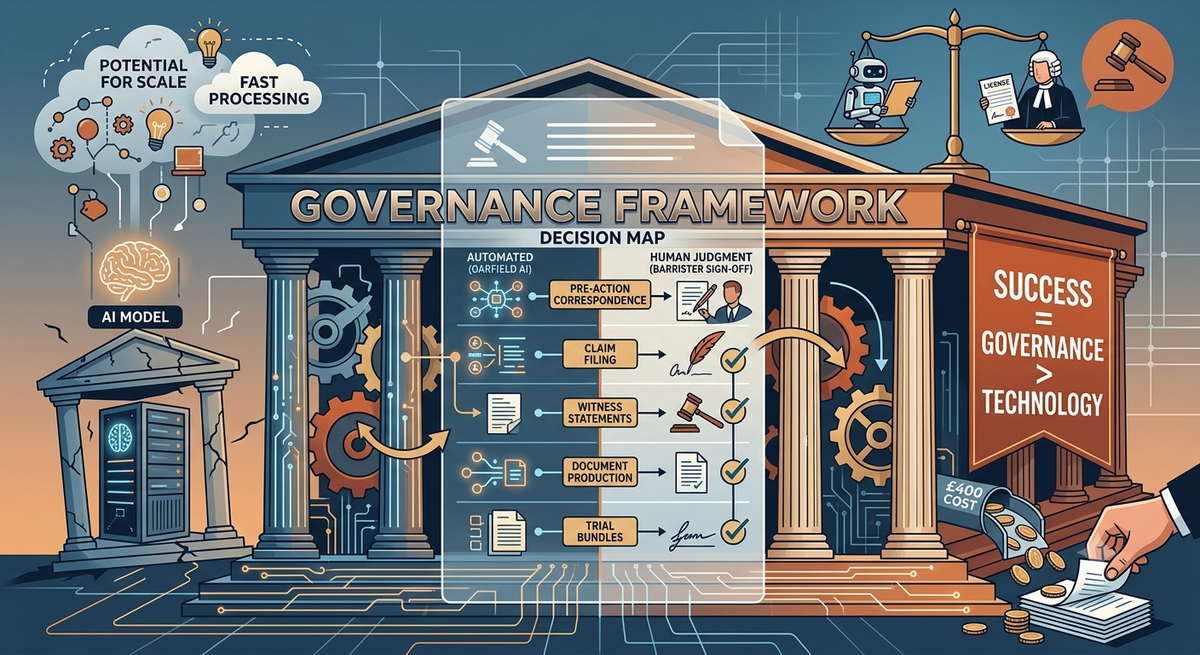
A claimant recently recovered roughly £7,000 in a UK court case. Preparing it, the pre-action correspondence, the claim itself, witness statements, document production, trial bundles, and the response to the defendant's counterclaim, cost about £400. Garfield AI handled nearly all of that work. A licensed barrister stood up in court.
Coverage has called this the first trial involving a "regulated AI lawyer," and most readers will take that as confirmation that software is starting to replace attorneys.
That's not the interesting part.
What's interesting is who decided, ahead of time, exactly which parts of a lawsuit a machine could touch and which parts stayed with a human. That decision, not the model behind Garfield, is the actual story. It's the one most coverage skipped past on the way to the more clickable headline.
The sentence everyone skipped
Garfield says it handled nearly the entire litigation preparation process: pre-action correspondence, filing the claim, witness statements, document production, trial bundles, and the response to the defendant's counterclaim.
Read quickly, that's a list of tasks a machine completed. Read slowly, it's a map of decisions someone made before any of those tasks started. Which parts of a case are structured enough to hand to software. Which parts require a license to touch. Where the file passes from one party to another, and who signs off when it does.
None of that is a technology decision. It's the pattern I keep coming back to when I write about this: most AI failures trace back to choices made before the model ever produces a document, not to anything the model does wrong.
Why the barrister mattered more than the AI
A human barrister argued the case. Obvious enough on its own. But it's also the hinge the entire arrangement turns on.
Garfield didn't try to remove lawyers from the process. It reorganized the work. Routine, structured, repeatable preparation went to software. Advocacy, judgment, and the accountability that comes with standing in front of a judge stayed with someone who carries a license that can be taken away.
That's a different thing than the phrase most firms reach for when asked what their governance looks like: "a lawyer reviewed the AI's output." Review after the fact catches mistakes. It doesn't answer who's on the hook for the case as a whole. Garfield's model answers that question before anything gets filed: oversight isn't bolted onto the end of the workflow. It's built into where authority sits at each step.
Governance came before scale
The sequence matters here too, not just the structure. Garfield operates inside a regulated legal framework. It didn't launch first and figure out the rules under pressure once something went wrong.
The order was closer to this: establish the regulatory relationship, define who's responsible for what, then deploy the software and let it earn trust through a track record of results.
That's the same order every high-risk industry has followed once AI-adjacent automation actually stuck. Aviation didn't get autopilot at meaningful scale until certification frameworks existed to govern it. Drug discovery software didn't reach patients until clinical trial and approval processes could absorb it. Algorithmic trading didn't clear regulators until capital requirements and audit trails caught up with it. Legal services looks to be running the same playbook now, just later than the others.
A policy is not a governance system
Plenty of firms think they've handled this because they have a one-page AI policy telling employees to "use AI responsibly." That sentence, on its own, could never have produced what Garfield built.
Getting software into a courtroom took real design work: deciding which parts of the workflow AI would own, defining roles across the human-AI handoffs, assigning responsibility for each output, building escalation paths for cases that don't fit the standard pattern, setting verification steps, and satisfying a regulator that all of it holds up. A policy communicates an expectation. What Garfield built is the system that makes the expectation achievable, which is the actual distinction between an AI policy and AI governance. Most firms haven't drawn that line yet.
The £400 number is a symptom, not the story
Coverage keeps landing on the economics: about £7,000 recovered against roughly £400 in fees. Read as a pricing story, that's a nice stat for a LinkedIn post.
Read as a governance story, the price is a downstream effect. Firms that define responsibility clearly, automate the parts of a case that don't need a law degree, verify output before it goes out the door, and keep a human accountable for judgment calls end up with a cheaper process almost as a side effect. The savings aren't the innovation. They're what governance looks like once it's actually running.
What malpractice insurers will start asking
This also changes what a professional liability underwriter should be asking a firm. The old questions were about tools: which vendor, which model, how much was spent. The newer ones are about governance maturity: which legal tasks can AI perform without sign-off, which decisions require a licensed attorney's approval, how AI output gets verified, who owns each decision if it goes wrong, how supervision gets documented, which matters are off-limits for AI entirely, and what evidence a firm can produce that any of this actually happened rather than just being written down somewhere.
Those aren't theoretical anymore. Underwriters are going to start asking them at the next renewal cycle, if they haven't already.
Where the chain actually starts
The public only sees the end of this: a case won, a headline, a receipt showing legal work for £400. Everything that made that possible happened earlier and out of view: who at Garfield decided the regulatory relationship was worth building before the product shipped, how the workflow got mapped against what a license actually requires, where the verification steps got inserted, who's accountable when a document is wrong.
Most writing about legal AI starts at the model. It should start with the system built around the model, because that's where the decisions that actually matter get made.
Worth being honest about scope, too. This was a debt claim, not a contested trial with live witnesses and a jury weighing credibility. Garfield's model has been proven on a case simple enough that "regulated AI lawyer" might be doing more rhetorical work than the facts support just yet. Whether the same governance architecture holds up on a complex commercial dispute, or a criminal matter, is a harder question, and this case doesn't answer it.
So the interesting question isn't whether Garfield can win more cases like this one. It's whether other firms can build the governance architecture underneath it before they try to copy the £400 number. The number is easy to copy. The architecture is not. Most firms still asking "what AI tools should we buy" are going to find that out the expensive way.