AI Governance Is Failing Before It Begins
Organizations here carry more exposure than if they had implemented nothing, because confidence now sits on top of a risk their governance stack cannot see.

The Shape of the Problem
There is a moment in every serious investigation when the pieces that have been examined individually suddenly resolve into a single, coherent picture. The separate findings stop being separate. They become a system. The name for the system becomes not just useful but necessary, because without the name, the response remains fragmented, and fragmented responses to systemic problems produce the illusion of action without the substance of it.
That moment is this article. And the name for the system is Governance Debt.
The preceding articles in this series have built the architecture of that system piece by piece. The accumulation: rational decisions made by capable people inside organizations that reward delivery over explainability, compounding quietly across years into a condition no single decision created and no single decision can resolve. The concentration: hand-off fractures at the boundaries between teams, where knowledge transfers incompletely, ownership dissolves, and the chain of accountability develops its most reliable breaks. The consequence: systems that cannot explain themselves when required to do so, not as an exceptional failure but as the predictable output of the way most enterprise systems have been built. The persistence: an accountability gap so structurally embedded that no existing function has the authority, visibility, or mandate to close it. The timeline: decades of compounding, burying, and misclassified surfacing that have left most organizations carrying far more debt than they know, in systems far more inaccessible than any remediation initiative has been scoped to address.
This is the condition that exists in most organizations today. It existed before AI arrived. It would have continued to exist, manageable at tolerable cost through reactive responses to episodic pressure, if the environment surrounding it had not changed.
The environment has changed. AI changed it. And the change is not reversible.
What AI Did Not Do
Precision matters here, because the instinct when AI governance fails is to locate the failure in AI itself, in the opacity of models, in the speed of deployment, in the novelty of the technology and the immaturity of the frameworks built to govern it. These are real concerns. They are not the primary one.
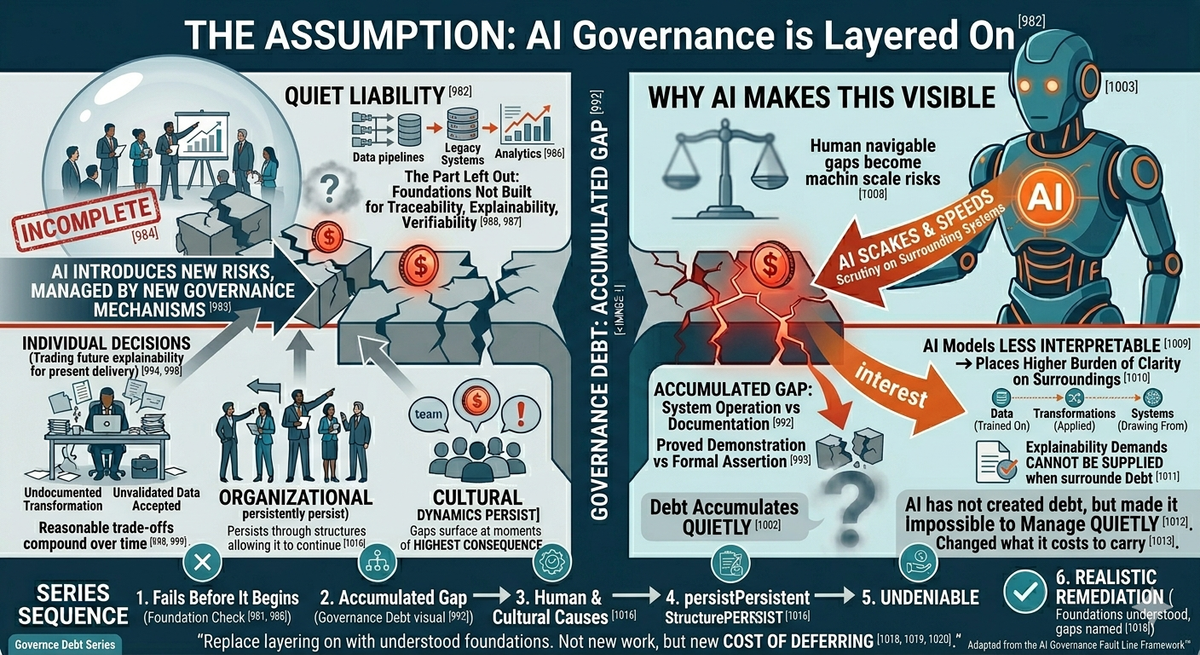
AI did not create Governance Debt. The debt was accumulating long before the first model was deployed. The data pipelines carrying incomplete lineage documentation, the legacy systems built on unvalidated assumptions, the hand-off fractures where accountability dissolves between teams, the audit vacuums where systems cannot reconstruct their own decisions, none of these originated with AI. They originated with the ordinary operational logic of organizations that had every incentive to deliver and limited incentive to document, to explain, and to maintain the verifiable chain of understanding that genuine governance requires.
What AI did was change what the debt costs. It changed the rate at which that cost is imposed. And it changed whether the management model that organizations have relied on, reactive, incident-by-incident, episodic, remains viable.
It does not. That is the finding this article delivers. And the implications of that finding extend to every AI governance initiative currently underway.
The Continuous Pressure Problem
For most of the period during which Governance Debt has been accumulating, organizations have managed its surfacing through a reactive model that was imperfect but functional. Audits arrived on predictable schedules. Regulatory examinations were bounded events with defined scope. Legal challenges were discrete and relatively infrequent. Between these events, the debt sat undisturbed. The gaps in documentation were real but quiescent. The hand-off fractures existed but were not being tested. The systems that could not explain themselves were not being asked to.
This model has a single structural dependency: the pressure to explain systems must be episodic. When explanation is demanded only at specific, bounded moments, an organization can direct concentrated effort at those moments, produce the best account available given the state of its systems, implement targeted remediation for the gaps that were exposed, and resume normal operations until the next event. The debt continues to accumulate between events, but the events are spaced in ways that make this approach workable. Not sustainable, the timeline article established that compounding ensures the eventual cost of reactive management always exceeds what proactive remediation would have required, but workable enough to persist as the dominant model across most industries for most of the past several decades.
AI removes the spacing. An AI system making consequential determinations at scale does not produce explainability demands at audit intervals. It produces them continuously, with every output, across every domain in which it operates. A model informing credit decisions, clinical pathways, hiring determinations, operational risk assessments, or regulatory classifications is not generating one accountability event per quarter. It is generating thousands per day, each of which is a potential point of challenge, each of which requires the same chain of verifiable explanation that the reactive model was designed to supply only on demand.
The intervals that made reactive management viable have been eliminated. The pressure that was episodic has become permanent. And the systems being asked to supply continuous explanation are the same systems that were already struggling to supply adequate explanation at episodic intervals, now carrying more debt than ever, with the buried layers of compounded accumulation that time has placed beyond the reach of targeted remediation.
This is not a governance framework problem. It is a foundation problem. And adding governance frameworks to inadequate foundations does not produce governed AI. It produces the appearance of governed AI, a condition that is, in some respects, more dangerous than the acknowledged absence of governance, because it generates organizational confidence that the risk is managed when the risk is merely obscured.
The Regulatory Formalization of an Impossible Standard
The continuous pressure problem would be significant on its own. It is compounded by a second transformation that AI has introduced into the environment: the regulatory formalization of explainability as an enforceable obligation.
For most of the history of Governance Debt accumulation, explainability was a best-practice aspiration. Organizations were encouraged to maintain documentation, to preserve audit trails, to ensure that decisions could be reconstructed. The encouragement was real but the enforcement was limited. Regulators could identify gaps, recommend remediation, and impose consequences in cases of egregious failure, but the standard against which organizations were measured was sufficiently flexible that partial explanation, supported by good-faith effort and institutional narrative, was generally adequate.
That standard is hardening. The EU AI Act imposes specific and enforceable explainability requirements on AI systems deployed in high-risk contexts, requirements that do not accept narrative approximation as a substitute for documented evidence. Model risk frameworks, building on guidance like the Federal Reserve's SR 11-7, are extending their reach into AI systems with expectations of validation, documentation, and traceability that assume the underlying data and systems are themselves well governed. Sectoral regulators in financial services, healthcare, and other consequential domains are developing AI-specific requirements that share a common assumption: that organizations can demonstrate, with verifiable specificity, how their AI systems reach the outputs they produce.
This assumption is not unreasonable as a regulatory standard. It is inconsistent with the actual condition of most enterprise systems. The regulators drafting these requirements are describing what governance should look like. They are not accounting for the decades of Governance Debt that make their requirements structurally difficult to meet in the systems to which they apply. The gap between the regulatory standard and the organizational reality is not a gap that better AI governance frameworks can close. It can only be closed at the level of the foundations, the data lineage, the transformation documentation, the system interaction maps, the chain accountability structures, that AI governance depends on and that Governance Debt has left incomplete.
Organizations that deploy AI governance frameworks without addressing their foundational debt are not meeting the emerging regulatory standard. They are constructing a compliance posture that will satisfy a surface examination and fail a rigorous one, which is precisely the examination that a challenged decision, a regulatory investigation, or a material AI failure will produce.
The Compound Failure of Layered Governance
There is a specific failure mode that the combination of continuous pressure and regulatory formalization produces, and it is worth naming directly because it is the failure mode that most current AI governance initiatives are structurally positioned to create.
When an organization implements AI governance on top of systems carrying significant Governance Debt, it produces what might be called layered governance: a well-designed oversight structure applied to a poorly understood foundation. The governance layer is real. Its components are genuine. The model validation processes catch real issues. The monitoring frameworks observe real signals. The oversight committees make real decisions. But their reach is bounded by the opacity of the systems beneath them, and that boundary is not marked, not measured, and not disclosed.
The organization does not know what its governance cannot see. It knows what has been reviewed and what has been flagged. It does not know what the undocumented transformation, the unvalidated data source, the uncharted system interaction, or the unresolved hand-off fracture has placed beyond the reach of its oversight. That unknown is not a theoretical space. It is the space in which undetected failures accumulate, in which regulatory exposure grows without triggering internal alerts, and in which the distance between the organization's confidence in its governance and the actual condition of its systems widens invisibly until it cannot be managed.
Layered governance produces an organization that is, in a precise and consequential sense, more exposed than one that has not implemented AI governance at all, because it has added organizational confidence to a situation that confidence is not warranted by, and because that confidence reduces the urgency of addressing the foundational conditions that genuine governance requires.
The Stakes, Named Precisely
The stakes of this condition are not abstract. They are organizational, regulatory, and operational, and they are arriving on a timeline that the compounding of Governance Debt and the acceleration of AI deployment are jointly determining.
Organizationally, the failure of AI governance on ungoverned foundations means that consequential decisions, decisions affecting people, assets, operations, and outcomes, are being made by systems that cannot be fully accounted for. When those decisions are challenged, the organization will not be able to provide the explanation that the challenge requires. That failure is not a governance framework failure. It is a foundation failure that the governance framework was never equipped to prevent.
Regulatorily, organizations operating in domains where AI explainability requirements are hardening are accumulating compliance exposure that their current governance posture cannot protect them from. The examination that will expose this exposure is not a hypothetical future event. It is the ordinary regulatory cycle, applied to AI systems, by regulators who are increasingly specific about what demonstration of explainability requires and decreasingly willing to accept narrative approximation as a substitute.
Operationally, the reactive model that has managed Governance Debt through targeted responses to episodic events is no longer adequate for an environment in which AI has made the pressure continuous. The resources, the organizational attention, and the remediation capacity that episodic management required are insufficient for continuous management. The model must change, and changing it requires addressing the foundational conditions that make continuous explainability possible, not as a parallel workstream to AI governance implementation, but as its prerequisite.
What the Series Has Built and Where It Goes
This series began with the human dynamics of Governance Debt accumulation, the rational decisions, the incentive structures, the cultural norms that make the debt a predictable outcome of organizational life rather than a product of negligence or incompetence. It moved through the structural architecture of where debt concentrates and why it persists. It introduced the time dimension and the compounding logic that makes the debt progressively harder to address with every year that passes. And it has arrived here, at the convergence: the moment when AI transforms the cost of carrying debt that organizations have been managing quietly for decades into a cost that can no longer be managed quietly at all.
The diagnosis is complete. The system has a name. The stakes are established.
What remains is confrontation and resolution, and the series now turns directly toward both. The articles that follow do not continue the investigation. They bring it into the reader's organization, with tools for self-assessment, frameworks for understanding the cost of the current condition, and a structured path toward the foundational work that makes AI governance real rather than present.
The question the next articles ask is not whether your organization has Governance Debt. The preceding articles have established that it almost certainly does. The question is whether your organization knows where it is, what it is costing, and what genuine remediation requires.
That is the work that cannot be skipped. And it begins now.
This article is part of the Governance Debt Framework™, a structured exploration of how modern organizations accumulate invisible risk as decisions, systems, and responsibilities drift out of alignment. The goal is to both diagnose the problem and provide a clear lens for understanding what happens inside complex organizations, and develop a path toward restoring systems that can explain, justify, and sustain the decisions they produce.