AI Governance Cannot Succeed on Ungoverned Foundations
Frameworks do not create those properties. They assume them.

The Series Has Turned to Face You
Until this point, the series has examined Governance Debt as an organizational condition: the dynamics that produce it, the structures that concentrate it, the systems it renders inexplicable, the authority vacuums that allow it to persist, the timeline along which it compounds. The diagnosis has been thorough. The system has been named.
Now it turns to face you directly.
Your organization. Not a generalized enterprise with representative characteristics. The one with its specific history of deferred documentation, its particular configuration of team boundaries and handoff fractures, its own audit vacuum and accountability gap. The one that almost certainly has AI governance initiatives underway, or planned, or recently completed. The one whose frameworks were designed with care and implemented with genuine intent.
The question this article asks is not whether those frameworks are well designed. They probably are. The question is whether the systems they govern can support them. That answer is not determined by the quality of the framework. It is determined by the condition of something the framework did not create and cannot substitute for: the foundational properties that make governance possible at all.
Governance Is a Dependent Structure
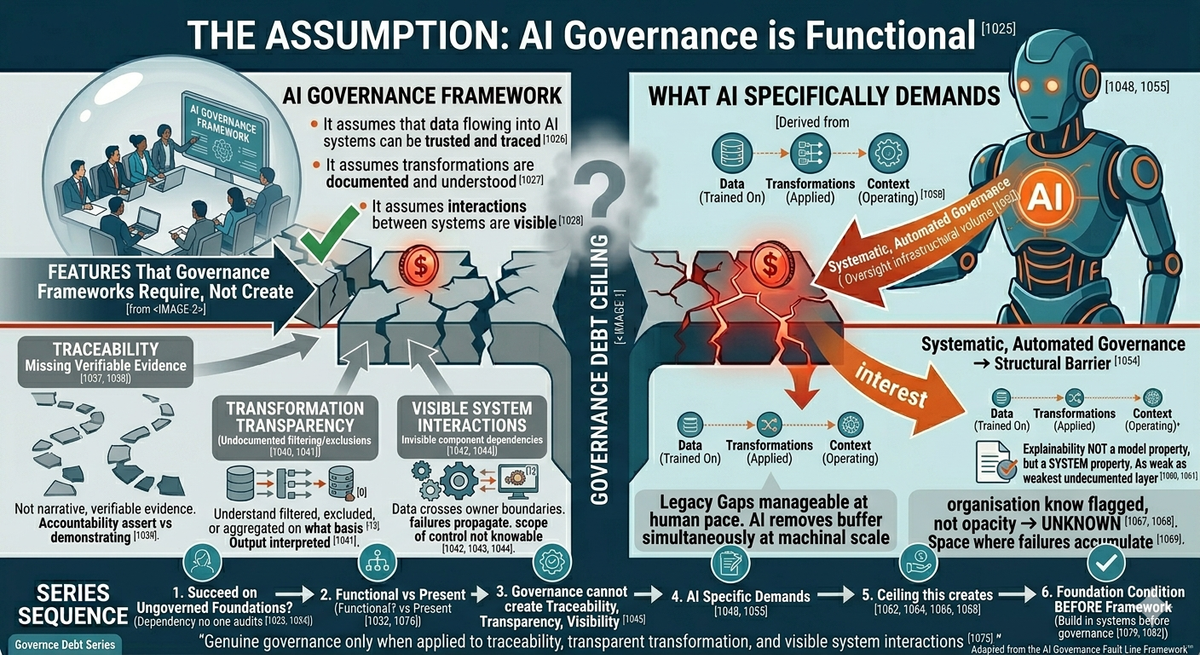
The most important thing to understand about AI governance frameworks, the thing most implementations proceed without fully confronting, is that they are dependent structures. Every component depends on conditions that must already exist in the systems the framework governs. Model validation depends on reliable, traceable training data. Monitoring depends on the observability of meaningful signals across the full system. Oversight depends on the ability to reconstruct decisions with enough fidelity to actually assess them. Accountability depends on a chain clear enough to assign responsibility along it.
These dependencies are not design flaws. They are the nature of governance itself.
You cannot govern what you cannot see. You cannot account for what you cannot trace. You cannot enforce standards on processes you do not fully understand. Governance frameworks are instruments of oversight. Those instruments require something to work against: a system whose behavior is observable, whose logic is traceable, and whose outputs can be connected, with verifiable evidence, to the inputs and decisions that produced them.
When that something is absent, when the system carries Governance Debt in the form of incomplete lineage, undocumented transformation, fragmented ownership, and buried assumptions, the governance framework does not fail in a way that is immediately visible. Committees meet. Validations are performed. Reports are produced. The organization has governance, in every formal sense. What it lacks is governance that reaches the full depth of the system it is meant to oversee.
It has governance with a ceiling. That ceiling is set not by the framework's ambition but by the foundation's condition. And almost no one inside the organization knows where the ceiling is.
The Three Properties Governance Cannot Create
Three foundational properties must exist before AI governance can function as intended. They are worth defining precisely, because the gap between a general understanding of these properties and a specific assessment of whether your systems actually possess them is the gap most AI governance initiatives have not crossed.
Traceability
Traceability is the ability to follow any consequential decision backward through every input, transformation, and rule that shaped it, producing verifiable evidence at each step. Not a narrative. Not a reconstruction from memory or inference. Documentation that existed at the time the decision was made, preserved in a form that can be produced and examined by someone who was not present when the system was built.
When a regulator, auditor, or legal challenge asks how a specific output was produced, the answer must be retrieved from contemporaneous documentation, covering every stage of the process, maintained with enough rigor to hold under adversarial scrutiny. Most organizations have traceability within domains. Very few have it across the full chain from data origin to AI output. The handoff fractures examined in article four are precisely where traceability breaks, and they are the first places regulators will look.
Ask yourself specifically: for the AI systems currently in production, can you trace the lineage of training data through every transformation it underwent before reaching the model? Can you produce that trace as documented evidence rather than reconstructed narrative? If the answer is uncertain, traceability is not a property your system possesses. It is an aspiration your governance framework assumes.
Transformation Transparency
Transformation transparency is the documented understanding of how data changes as it moves through systems: what was filtered, aggregated, normalized, joined, excluded, or recoded; on what basis; under whose authority; and with what validation. Knowing that data was transformed is not sufficient. Transformation transparency requires knowing precisely how, and being able to demonstrate that the transformation was appropriate, intentional, and consistently applied.
This matters because AI models are acutely sensitive to the characteristics of the data they learn from. A normalization decision that seemed inconsequential at implementation can shape model behavior in ways that are significant and non-obvious. An exclusion criterion applied to training data can introduce systematic bias that manifests in outputs affecting real people and real decisions. If the transformation logic exists only in unannotated code, in the memory of engineers who have moved on, or in practices that evolved organically without formal specification, then model behavior cannot be fully explained regardless of how thoroughly the model itself has been validated.
Regulatory frameworks now being applied to AI systems are increasingly specific on this point. The EU AI Act's requirements for high-risk AI systems include data governance obligations that assume transformation logic is documented and auditable. SR 11-7, extended to AI contexts by financial regulators, expects that model inputs can be fully characterized and their preparation fully explained. These are compliance requirements being imposed on systems whose transformation documentation, in most organizations, was never built to meet them.
Visible System Interactions
Visible system interactions means a clear, current map of how components depend on one another: where data crosses ownership boundaries, how the outputs of one system become the inputs of another, how failures in one layer propagate downstream, and what each component assumes about the reliability of what it receives. An architecture diagram accurate at the time of the last major implementation and not systematically updated since does not satisfy this.
This is the property most consistently absent in complex enterprise environments, and its absence is the most consequential for AI governance specifically. AI systems operate within networks of upstream data sources, transformation pipelines, integration layers, and downstream consumption contexts. Governing the AI system without governing the network means observing what the system produces while remaining unable to explain why it produces it, or what would need to change to produce something different. That is not oversight. It is monitoring with a blind spot.
What Regulators Are Actually Looking For
The regulatory environment surrounding AI has moved faster than most internal governance programs have tracked. The direction is consistent across jurisdictions: toward specificity, enforceability, and an expectation that organizations demonstrate foundational governance conditions rather than simply assert them.
The EU AI Act requires technical documentation covering training, validation, and testing data, including provenance, collection methods, processing steps, and known limitations. It requires logging sufficient to enable post-hoc auditability. It requires that organizations demonstrate ongoing compliance. None of these requirements describe a documentation exercise that can be completed after the fact. They describe a discipline of operational governance that must be embedded from the beginning and maintained continuously.
SR 11-7 expects that model development documentation covers not just the model but the data used to build it: sources, quality assessment, transformations applied, and judgments made in its preparation. It expects that models can be validated by parties independent of their development. That requires documentation sufficient for an independent party to understand and assess the full development process. Not a summary. The full process.
Sectoral regulators in healthcare, insurance, and employment share these expectations: that the data underlying AI systems is governed, that its transformation is documented, that the system's behavior can be explained with specificity, and that accountability can be assigned through a chain that is clear and verifiable.
What none of these frameworks account for is the Governance Debt most organizations are carrying in the systems their AI depends on. The gap between what regulators expect to find and what most enterprise systems actually contain did not accumulate because of poor governance framework design. It accumulated over years, before any AI system was deployed, through decisions that seemed reasonable at the time and were never documented well enough to reconstruct afterward.
The Governance Posture Problem
There is a specific organizational risk that arises when AI governance frameworks are implemented on ungoverned foundations. It is more serious than non-compliance.
It is false assurance.
An organization with no AI governance framework knows it has no framework. That discomfort creates pressure toward remediation. An organization that has implemented a governance framework on ungoverned foundations believes it has addressed the risk. It has committees, policies, validation processes, monitoring dashboards. It can demonstrate governance activity to internal stakeholders and external examiners. The discomfort has been resolved, not by addressing the foundational conditions that create the risk, but by constructing a governance posture that makes the risk less visible.
The organization is not being dishonest. Its framework is genuine. But its confidence in that framework is calibrated against the framework's design rather than against the condition of its foundations. And the foundations are what determine how far the framework's reach actually extends.
The posture holds until the examination is rigorous enough to reach the foundation's level. A routine audit scoped to the governance framework itself will find the framework in order. A regulatory examination that probes the documentation underlying a specific AI output, tracing it through the transformation pipeline to its data sources, will find the foundations. A legal challenge requiring end-to-end reconstruction of a consequential decision will find the foundations. The posture survives the surface examination. It fails the one that matters.
In an environment where AI systems are making consequential decisions continuously, at scale, across domains subject to increasing regulatory specificity, the examination that matters is not a hypothetical future event. It is the next significant challenge to a decision your AI system has already made.
The Ceiling You Cannot See
Your organization's AI governance framework has a ceiling. Every framework applied to systems carrying Governance Debt has one. The ceiling is set by the furthest point upstream to which your governance can actually trace accountability, with verifiable evidence, today. Not in principle. Not with sufficient effort and goodwill. With the documentation that currently exists and the organizational structures currently in place.
Most organizations do not know where their ceiling is. They know what their governance framework covers. They do not know which undocumented transformation, unvalidated data source, uncharted system interaction, or unresolved handoff fracture has placed something beyond the framework's reach. That unknown is not theoretical. It is where your unmanaged AI governance risk currently lives.
Locating the ceiling is not a governance framework activity. It is a foundational assessment: a systematic examination of whether the three properties governance requires actually exist in the systems your AI depends on. That examination is uncomfortable. It will almost certainly reveal a ceiling lower than your current governance posture implies. It will surface gaps the framework assumed were addressed. It will make the distance between governance as designed and governance as functional visible in ways that demand a response.
Proceeding without it, continuing to implement and refine frameworks on foundations whose condition has not been assessed, is not a prudent approach to a difficult problem. It is the deliberate construction of a governance posture calibrated for surface examination, in a regulatory environment moving rapidly toward the kind of examination that reaches the foundations.
The next article asks you to begin that assessment. It offers a single, specific, and deliberately uncomfortable test. It will not tell you everything about your foundational condition. It will tell you enough to know whether the ceiling is where you think it is.
That knowledge is not optional. It is the beginning of governance that is real.
This article is part of the Governance Debt Framework™, a structured exploration of how modern organizations accumulate invisible risk as decisions, systems, and responsibilities drift out of alignment. The goal is to both diagnose the problem and provide a clear lens for understanding what happens inside complex organizations, and develop a path toward restoring systems that can explain, justify, and sustain the decisions they produce.