Governance Debt: A Series Introduction
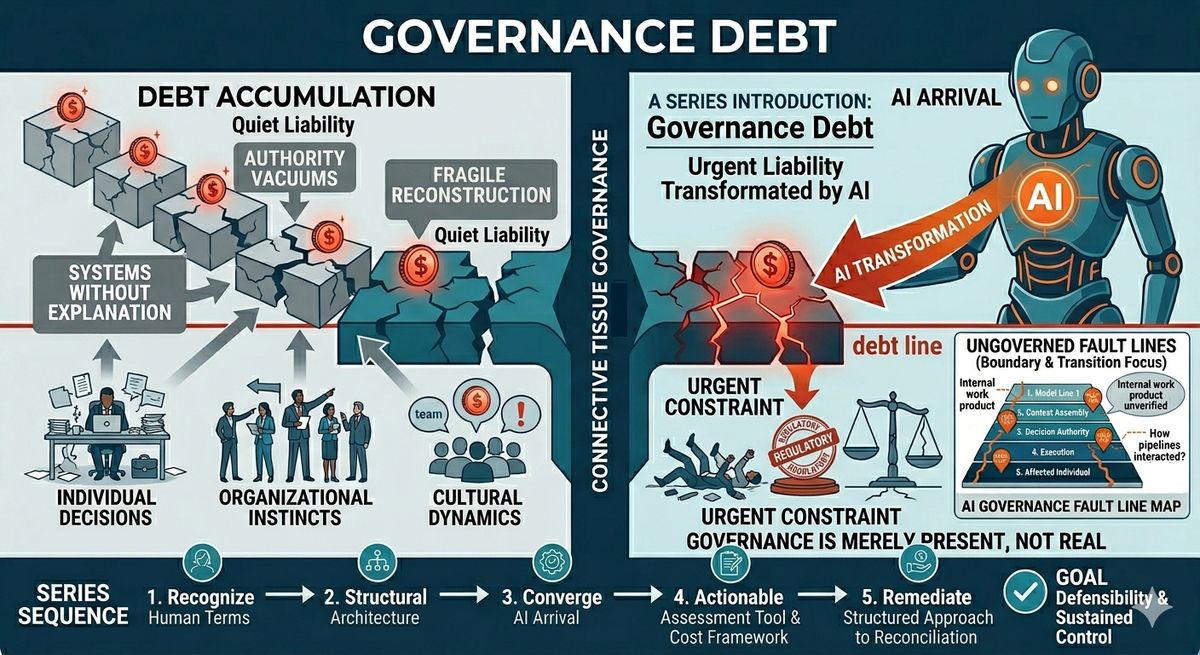
There is a condition present in most organizations today that has no widely shared name, generates no alerts, appears in no standard reporting and yet it is shaping the limits of what those organizations can know about themselves, account for under scrutiny, and govern with confidence. It exists in the gap between how systems are documented and how they operate; between what an organization formally asserts about its processes and what it can demonstrate with verifiable evidence; between the governance that appears in policy documents and the governance that functions when a consequential decision is challenged and must be reconstructed, end to end, with proof.
That condition is Governance Debt. The reason this series exists now, rather than five years ago, is that AI has transformed it from a background liability into an urgent and unavoidable one. Organizations deploying AI governance frameworks are discovering that those frameworks depend on foundational conditions that their systems were never built to provide. The debt that accumulated quietly across years of rational operational decisions is now the constraint that determines whether AI governance is real or merely present.
This series is a structured examination of that condition: where it comes from, how it is built into the architecture of modern organizations, what it costs, and what genuine remediation requires.
It moves through five phases, and the sequence is not arbitrary. Each phase is designed to produce the understanding that the next one requires, which means that arriving at the resolution articles without having traveled through the earlier ones is like arriving at a diagnosis without the examination that made it possible. You can read any article in isolation and find it useful. You can follow the sequence and find it transformative. The difference is the difference between recognizing a problem and understanding it well enough to address it.
The series begins by making Governance Debt recognizable in human terms, in the individual decisions, the organizational instincts, and the cultural dynamics that cause it to accumulate not through negligence but through the entirely rational behavior of capable people inside systems that never demanded otherwise. It then moves into the structural architecture of where debt concentrates: the boundaries between teams, the systems that cannot explain themselves, the authority vacuums that ensure no one is positioned to repair what accumulates at the seams. From there it converges into the moment AI arrives in this condition and changes what it costs to carry it, permanently and at scale. The series then turns to face the reader's own organization directly, with a self-assessment tool designed to locate the governance ceiling in specific, actionable terms, and a cost framework designed to make the financial and regulatory stakes concrete enough to act on. It closes with method: the structured approach to reconciliation that establishes the foundational conditions genuine AI governance requires, and an honest account of what sustained control over AI systems actually looks like in practice, not as a destination to be achieved, but as a discipline to be maintained.
What this series asks of you is intellectual honesty and sequential engagement. The intellectual honesty to examine your own organization's systems against the standards the series establishes, rather than reading at the comfortable distance of someone assessing another organizations' problems. The sequential engagement to follow the argument as it builds rather than extracting the pieces that feel most immediately relevant and setting the rest aside. What it delivers in return is not a framework, a maturity model, or a checklist. It is a clear, grounded, and practically actionable understanding of what Governance Debt is, where it lives in your organization, what it is costing you, and what the work of addressing it actually requires. That understanding is only available at the end of the sequence. The individual articles are steps toward it, not substitutes for it.
The series is written for people who carry real organizational responsibility for the systems, the governance, and the decisions that Governance Debt affects; that is, leaders in risk, compliance, technology, data, and AI governance who are intelligent, experienced, and appropriately skeptical of content that promises clarity on complex problems without earning it. The goal is to earn it.
Begin with Article 1, The Illusion of Soundness: Why Organizations Trust Systems They've Never Actually Examined, which will ask you to examine something about the way capable, experienced people relate to complex systems that most professional development has never asked you to look at directly.
*This article is part of the Governance Debt Framework™, a structured exploration of how modern organizations accumulate invisible risk as decisions, systems, and responsibilities drift out of alignment. The goal is to both diagnose the problem and provide a clear lens for understanding what happens inside complex organizations, and develop a path toward restoring systems that can explain, justify, and sustain the decisions they produce.*